
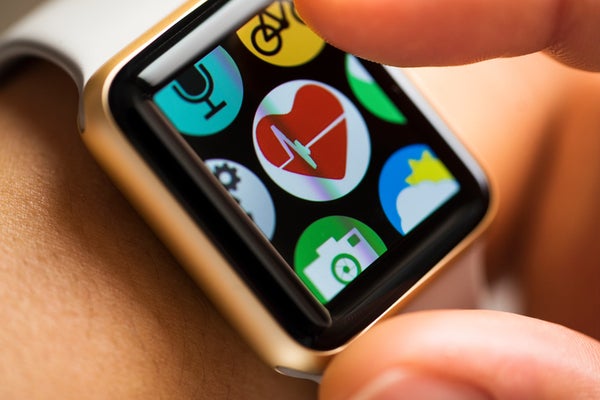
When the new Apple Watch heart monitoring app can get a reading, it can accurately detect that a person has an irregular heart rhythm known as atrial fibrillation 99 percent of the time, according to a study of the new device that Apple submitted to the Food and Drug Administration.
The agency shared with STAT a summary of the clinical data that Apple submitted as part of its clearance application.
In one study, Apple tested the watch in more than 580 people, half of whom had atrial fibrillation. The app couldn’t read about 10 percent of the heart rhythm recordings in the study. When it looked at the rest, though, the app was very accurate: It caught more than 98 percent of people with atrial fibrillation, and correctly told people that they didn’t have the condition 99.6 percent of the time.
On supporting science journalism
If you're enjoying this article, consider supporting our award-winning journalism by subscribing. By purchasing a subscription you are helping to ensure the future of impactful stories about the discoveries and ideas shaping our world today.
Atrial fibrillation is a condition associated with a higher risk of stroke and heart failure. It happens when the parts of the heart don’t beat together correctly.
The second submitted data set was part of Stanford’s Apple Heart Study. For it, Apple examined 226 people that the app classified as having an irregular heart rhythm—but not necessarily atrial fibrillation. Those individuals wore both the Apple Watch and a traditional, wearable heart monitor and moved around normally for about a week.
During the monitoring period, about 41 percent of people had an irregular heart rhythm or event that looked like atrial fibrillation show up on their traditional monitors. In about 79 percent of those cases, the app also picked something up.
Going after atrial fibrillation first makes sense, said Dr. Sekar Kathiresan, a physician-scientist at Massachusetts General Hospital and the Broad Institute who studies the genetic risk factors for cardiovascular disease.
“It’s an important disease. As far as heart rhythm disturbances go, it’s the most common,” he said “It’s a condition where, often, the first presentation is stroke. And it’s a condition that if you catch it early, there’s an effective treatment—blood thinners. In many ways, it’s kind of an ideal scenario for a screening test.”
Kathiresan said the most important data point for consumers answers a simple question: if the app gives a problematic reading, how likely is it that the reading is correct?
That figure is the app’s “positive predictive value,” and Kathiresan calculates that for people using Apple’s EKG app to look for atrial fibrillation, that number is about 45 percent. He based that calculation on the figures from the studies FDA shared.
More than half the time the app flags a problem, then, the app will be wrong.
“For even a very accurate test in a condition that is [uncommon], most of the tests that are going to come back will be false positives,” Kathiresan said.
Doctors whose patient populations sport Apple Watches may need to brace themselves for an influx of patients who will want to see a specialist when they receive an irregular heart rhythm alert, Kathiresan said.
Young people with disposable income—like many current Apple Watch users — are among the least likely to have atrial fibrillation, he added. For them, he said “it’s even more likely that a positive result will be a false positive.”
Apple may be targeting older consumers with this new version of the watch, particularly since the watch will also come with fall detector that can alert emergency services if the wearer doesn’t move for a minute.
Apple did not immediately respond to a request for comment.
Republished with permission from STAT. This article originally appeared on September 13, 2018