
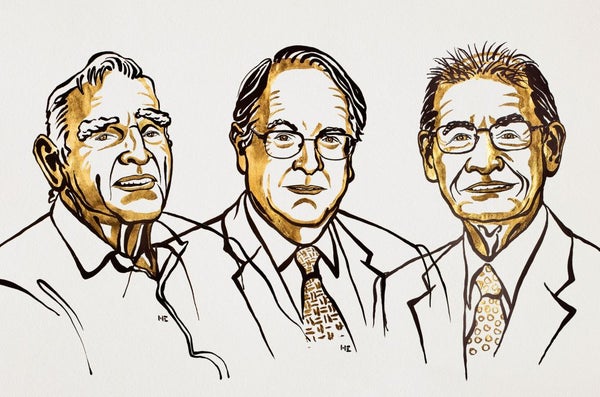
“This is a highly charged story,” began Olof Ramstrom, a member of the Nobel Committee for Chemistry, explaining why his group today awarded the Nobel Prize in Chemistry to a trio of scientists who spent decades developing the lithium-ion battery. These batteries, small and powerful as compared with older battery technology, made possible pocket-sized mobile phones, laptop computers, electric cars and renewable-energy devices such as solar panels that can help address the problems of climate change, Ramstrom said.
The prize will be shared by John B. Goodenough of the University of Texas at Austin, M. Stanley Whittingham of Binghamton University, State University of New York, and Akira Yoshino, who works at Asahi Kasei Corporation and Meijo University in Japan. They will split the nearly $1-million award.
Lithium batteries have been touted as Nobel-worthy for years, says Bonnie Charpentier, president of the American Chemical Society. “I think that it’s magnificent that Goodenough won this year,” she says, noting that at age 97, he is the oldest Nobel laureate. Yoshino is 71, showing that the research stretched across generations.
On supporting science journalism
If you're enjoying this article, consider supporting our award-winning journalism by subscribing. By purchasing a subscription you are helping to ensure the future of impactful stories about the discoveries and ideas shaping our world today.
Indeed, it was in the 1970s that Whittingham began investigating the use of lithium, the smallest and lightest metal in the periodic table of the elements. That size and weight made it possible to pack a lot of lithium into a small space, unlike the large and heavy lead-acid batteries that dominated at the time. Lithium had another advantage: it easily gave up its electrons, and batteries produce electricity when electrons flow from one end, called the anode, to the other, called the cathode. Whittingham put metallic lithium in one end and a layered material called titanium disulfide at the other; the titanium had spaces that could capture the flowing electrons.
But this combination of materials had the unfortunate potential to explode.
Around 1980 Goodenough switched out the titanium for another layered material, cobalt oxide, which proved to be more stable. His battery was also more powerful, doubling Whittingham’s two-volt capacity to four volts. Then, in 1985, Yoshino changed the material at the anode end of the battery to something called petroleum coke, to which he could add lithium. Electrons flowed easily and safely between the two ends without reacting with surrounding materials and degrading them.
This combination of qualities gave Yoshino’s battery a long life and meant it could be recharged multiple times without losing performance. In 1991 a Japanese company began selling the first commercial version of this battery, and a new world of mobile electronics began to take shape.
Editor’ Note (10/9/19): The headline in this story was edited after posting to correct the date of the award.