
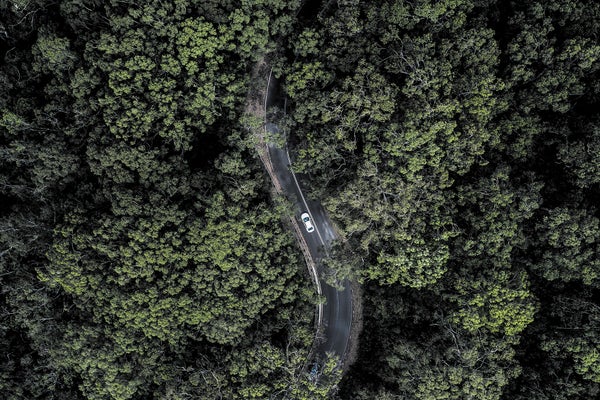
Life on our planet is characterized by a preference for particular forms of various molecules over their mirror images. DNA molecules, for example, always have a “right-handed” curl, whereas all known life uses only “left-handed” amino acids to build proteins. Nonliving matter typically shows no such preferences. Researchers have seized on this distinction to design an instrument dubbed FlyPol, which uses light to track plant life from a fast-moving helicopter more than a kilometer overhead.
When light reflects off a concentration of molecules with the same handedness, called homochiral molecules, some of this light becomes circularly polarized: the reflected waveforms corkscrew in a clockwise or counterclockwise direction. FlyPol, a spectropolarimeter, measures how much light is transformed in this way as it bounces back from sunlit landscapes. The quantity of this polarized light, observed over a range of wavelengths, is like a fingerprint that reveals not only the type of organism (grass, tree or alga—FlyPol is calibrated for plants) but also details about its health. Inanimate sources have profiles with no discernible features.
“The signal in plants is strongly dependent on the larger-scale molecular structure,” says University of Bern astrobiologist Lucas Patty, lead author of a new paper describing FlyPol in Astronomy & Astrophysics. “If the plant is under drought stress, for example, the membranes can swell a bit”—and that comes through in slightly flattened intensity peaks of reflected light. Patty says the technique could help assess the health of ecosystems affected by climate change, deforestation or the spread of invasive species.
On supporting science journalism
If you're enjoying this article, consider supporting our award-winning journalism by subscribing. By purchasing a subscription you are helping to ensure the future of impactful stories about the discoveries and ideas shaping our world today.
Until recently, stable measurements were possible only in controlled laboratory settings because they involve such a tiny portion of the detectable light. But FlyPol upgraded the lab setup to work in the field. “Overall, it's just a really cool result,” says Massachusetts Institute of Technology astrochemist Brett McGuire, who was not involved in the study. “They pretty convincingly show that they can discriminate between areas that have an awful lot of life versus areas that don't.”
Perhaps most enticing is the method's potential to someday scan for life on other planets. Scientists currently know of no other mechanisms, besides molecules generated by life, that can cause complex circularly polarized light signals. Although life elsewhere might exist without homochiral molecules, their presence would be a solid hint of something living. “It's one of the few ways of detecting life that is essentially free of false positives,” Patty says—although he notes that significant hurdles remain before this detection process would be feasible.
When scanned from near Earth, such a signal would be extremely faint in planets around distant stars, according to M.I.T. astrophysicist Sara Seager, who was also not part of the study. “It's hard to say if we could pull this off in the next generation of telescopes,” she says. “It's probably a couple of generations down the line.” Yet Seager says this methodology and experiment, with real-world flora measurements, are a great start to someday studying faraway worlds.
For now next steps include testing FlyPol over more landscapes and collaboration on an instrument to measure Earth's signals from the International Space Station. “From the ISS the spatial resolution will still be quite high,” Patty says, so one would expect to get large signals when measuring above the Amazon, for instance, and flat signals from Antarctica.