
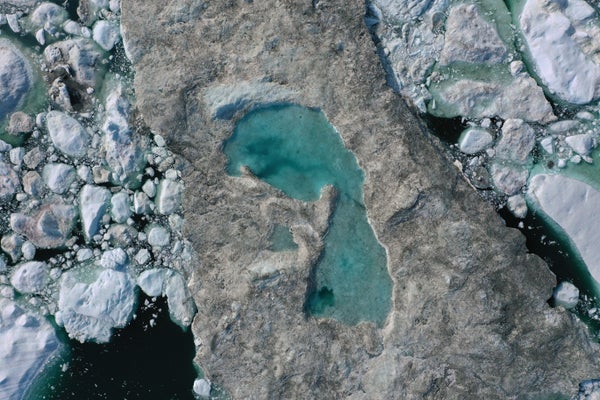
A significant melt event is unfolding in Greenland this week.
With temperatures nearly 20 degrees Fahrenheit higher than usual in some areas, the southern part of the ice sheet is melting at its highest rate this season. Forecasts suggest that the melting on Greenland’s South Dome—one of the highest elevations on the ice sheet—may be the strongest for early June since 1950.
It worries experts that Greenland could be priming for another big melt season.
On supporting science journalism
If you're enjoying this article, consider supporting our award-winning journalism by subscribing. By purchasing a subscription you are helping to ensure the future of impactful stories about the discoveries and ideas shaping our world today.
Early melting this spring, low snowpack in some areas and the potential for strong high-pressure weather systems later this summer have all raised red flags. Scientists are paying close attention after last summer’s record-breaking ice loss—an event scientists expect to occur more frequently as the Arctic continues to warm.
Scientists typically define the beginning of melt season as the first three-day period in which melting is observed across at least 5% of the ice sheet. This year, that period began on May 13—nearly two weeks earlier on average over the last few decades.
The melting coincided with a heat wave across much of the Arctic. Siberia and the central Arctic were some of the hardest-hit regions. But temperatures skyrocketed in parts of Greenland, as well, after an otherwise chilly start to the month.
At the same time, snow began rapidly disappearing along the margins of the ice sheet, exposing bare rock and ice. The lack of snow is one factor increasing the possibility of an above-average melt year, according to Jason Box, an ice expert with the Geological Survey of Denmark and Greenland.
Snow plays an important role in the Arctic. Its bright surface helps to reflect sunlight away from the Earth. When snow disappears, more heat is able to get through and warm the surface. That, in turn, can cause faster melting.
The exposure of bare ice is happening earlier than usual this year, according to Box.
“Like last year, a dearth of snow along the western ice sheet preconditioned stronger than normal ice loss because the seasonal snow shields the dark bare ice with a bright reflective cover,” he told E&E News by email. “So, all else equal, we can expect more melt this year.”
Xavier Fettweis, a polar climate scientist at the University of Liège in Belgium, agreed that the lack of snow can pose a risk. He added that warm events are also necessary to kick-start the feedback process.
The ice sheet is in the midst of one now. And the fact that melting is happening at such high elevations, where snowpack tends to be stronger, may be cause for some concern.
The melting at South Dome, for instance, is likely to make the snow wetter and denser, according to Fettweis. That will diminish its ability to reflect sunlight and to absorb meltwater that forms on the surface of the ice sheet.
“Such an event so early in the season will certainly favour an above-average melt season this year,” he told E&E News in an email.
It’s possible that more heat waves are on the way.
According to Judah Cohen, director of seasonal forecasting at the analytics firm Atmospheric and Environmental Research, model forecasts suggest strong high-pressure events over Greenland this summer. High-pressure systems are often associated with warming on the ice sheet.
In fact, a recent study concluded that last summer’s extreme melting was linked to abnormally persistent high-pressure systems over Greenland (Climatewire, April 16). Greenland’s melt rates last year were second only to those in 2012—and the total amount of ice lost was actually the highest on record.
This summer’s forecasts seem to suggest the high-pressure systems will be most intense in July. And they may affect larger swaths of the ice sheet than the current melt event, which is mainly limited to the southern part of the ice sheet.
Cohen cautions that there’s still considerable uncertainty about forecasts this far in advance. It’s too early, for now, to say whether these events will definitely occur.
But if the forecast is accurate, he said, it’s “definitely suggestive of high melt over the ice sheet.”
In general, he added, the forecast is in keeping with research indicating that these high-pressure systems are becoming more frequent over Greenland. Some scientists believe that climate change, which can alter the structure and flow of the atmosphere, is partly to blame.
“Nothing is impossible; there’s always variability,” Cohen said of this summer’s forecasts. “But I think just the background would support a continuation of this pattern of high pressure in and around Greenland.”
None of the events this spring necessarily promises a melt season like last year. But put together, with the threat of more heat events this summer, they do suggest cause for a watchful eye on Greenland this season.
Reprinted from Climatewire with permission from E&E News. E&E provides daily coverage of essential energy and environmental news at www.eenews.net.