
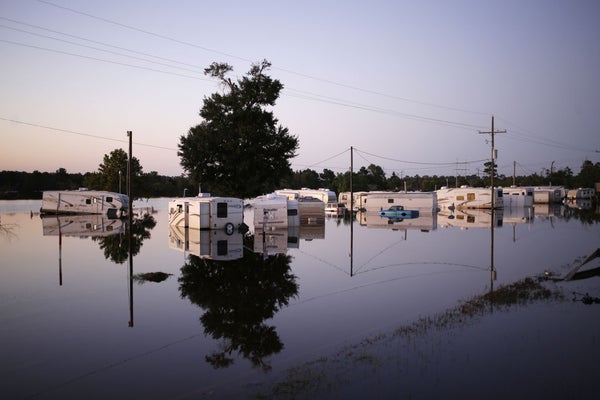
A revision of peak rainfall estimates in Texas could reshape future development, including the way buildings, highways, bridges and other infrastructure are constructed in floodplains.
In an update to the “Precipitation-Frequency Atlas of the United States,” or Atlas 14, NOAA determined that major storm events across the southern half of Texas produce substantially more rain than earlier thought.
The new estimates, which NOAA officials describe as “the federal government’s authoritative source of precipitation frequency estimates” for all 50 states and U.S. territories, provide the underpinning for much of the nation’s local building codes and design standards in floodplains.
On supporting science journalism
If you're enjoying this article, consider supporting our award-winning journalism by subscribing. By purchasing a subscription you are helping to ensure the future of impactful stories about the discoveries and ideas shaping our world today.
They also help delineate flood risk in communities across the country, guide development decisions to comply with the Federal Emergency Management Agency’s National Flood Insurance Program, and help the National Weather Service monitor precipitation events that could lead to flooding.
While rainfall frequency values vary widely from state to state, and sometimes within states, the new estimates for Texas are particularly important in places like Houston, where officials are working to reduce future flood risk by building homes, businesses and infrastructure higher and stronger than before last year’s Hurricane Harvey.
They also carry considerable significance in an era of climate change, when scientists have drawn clear links between heavier and more frequent peak rainfall events and a warming climate.
“It certainly is a big deal,” said Wes Birdwell, government relations committee chairman for the Texas Floodplain Management Association, which represents 2,400 floodplain managers, hazard mitigation specialists and insurance adjusters in the Lone Star State.
“We’re the first- or second-fastest-growing state in the country, and we have the second-highest flood damage next to Louisiana, so we needed to do something to improve the quality of our data,” Birdwell added.
As an example of just how far off the old values were, NOAA cited updated findings for two major Texas cities, showing that a 100-year rain event will produce considerably more precipitation than previously thought.
A 100-year storm is one that occurs on average every 100 years, or that has a 1 percent chance of happening in any single year.
In Austin, for example, a 100-year storm over 24 hours is now expected to produce as much as 13 inches of rain, compared to 10 inches using the old system. And in Houston, the 100-year event will produce 5 additional inches of rain, from 13 to 18 inches.
Moreover, storms previously classified as 100-year events in the Houston region would now be considered 25-year events, NOAA said.
While the new Texas rainfall estimates were released nationally yesterday, officials in the Lone Star State have known for months that the update was coming, Birdwell said.
And some communities have already adopted new floodplain regulations or are planning to.
In Houston, the city council adopted a more restrictive building code last April. It requires that all new homes, as well as those being expanded by 33 percent or more, must be built 2 feet above the 500-year floodplain.
The old standard, which was in place during Harvey, required homes to be built 1 foot above the 100-year floodplain, as required by FEMA for communities to be eligible for federal flood insurance.
Harris County commissioners recently earmarked $14.5 million for updated floodplain maps that will provide a more accurate picture of the Houston metro area’s flood risk.
In Austin, the city’s Watershed Protection Department initiated its own floodplain management reforms early this month. Like Houston, Austin is considering requiring new construction to account for the 500-year floodplain, and it expects to have new FEMA flood maps drafted within the next few years.
Reprinted from Climatewire with permission from E&E News. E&E provides daily coverage of essential energy and environmental news at www.eenews.net.