
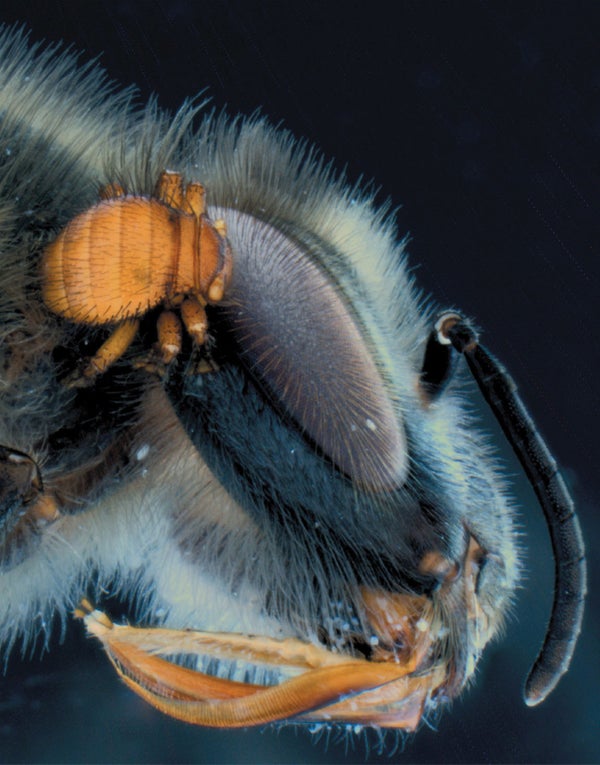
To wrangle a ride on their honeybee hosts, wingless parasitic flies need a truly phenomenal grasp. Now a new study reveals how Braula coeca manages to walk around on a flying bee while exhibiting what researchers say is the highest attachment force per body weight of any land-based insect ever measured.
This force relies on the parasite’s highly adapted feet, called tarsi, which are equipped with toothed claws. Each foot has a total of 28 teeth, or claw tips, which let the parasite lock onto sparse honeybee hairs during flight.
“The claws are unique, from what we know so far. Usually insects have claws with one tip only. A few species have two to three tips. But this species possesses comblike claws with several tips and deep interstices [gaps],” says Thies Büscher, a zoologist at Germany’s Kiel University and co-lead author of a recent study in Physiological Entomology.
On supporting science journalism
If you're enjoying this article, consider supporting our award-winning journalism by subscribing. By purchasing a subscription you are helping to ensure the future of impactful stories about the discoveries and ideas shaping our world today.

Source: “The Exceptional Attachment Ability of the Ectoparasitic Bee Louse Braula coeca (Diptera, Braulidae) on the Honeybee,” by Thies H. Büscher et al., in Physiological Entomology: How Insects Work—Linking Genotype to Phenotype; November 29, 2021 (https://doi.org/10.1111/phen.12378)

Source: “The Exceptional Attachment Ability of the Ectoparasitic Bee Louse Braula coeca (Diptera, Braulidae) on the Honeybee,” by Thies H. Büscher et al., in Physiological Entomology: How Insects Work—Linking Genotype to Phenotype; November 29, 2021 (https://doi.org/10.1111/phen.12378)

Source: “The Exceptional Attachment Ability of the Ectoparasitic Bee Louse Braula coeca (Diptera, Braulidae) on the Honeybee,” by Thies H. Büscher et al., in Physiological Entomology: How Insects Work—Linking Genotype to Phenotype; November 29, 2021 (https://doi.org/10.1111/phen.12378)
The claws are complemented by soft lateral ridges and “stoppers” along the foot, letting the fly swiftly break its rigid grip with a simple twisting motion and detach from the hairs as it moves—a trait likely to be intriguing to researchers working in biology-influenced design, or biomimetics. The parasite’s feet also feature pads that firmly cling to smooth surfaces, such as the wax in beehives.
“Other strongly attaching animals either secrete strong glues or anchor with structures that damage the surface,” Büscher says. “Both solutions are more or less permanent and do not allow for fast detachment and locomotion.” But because B. coeca’s grasping mechanisms are purely mechanical, they could prove useful for both terrestrial and underwater robots.
“Attachment technology is a prominent domain within biomimetic research,” says Shoshanah Jacobs, an integrative biologist at the University of Guelph in Ontario, who was not involved in the research. Jacobs agrees with Büscher on the finding’s potential value but notes that designers working on attachment problems might not readily become aware of such discoveries in insect physiology.
“Biomimetic researchers grapple with the challenges of knowledge mobilization across disciplinary silos,” Jacobs says. “When we’ve figured out how to do this better, we may very well be opening a floodgate of innovation.”