
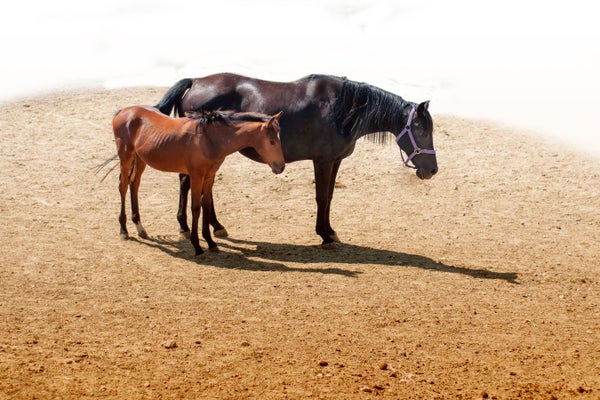
If you've ever passed by a field of horses at night, you've probably noticed that they rarely lie down to sleep. So why do these mammals sleep standing up?
The answer is one of survival: Horses slumber while standing to balance their need for sleep against the ever-looming threat of predators.
Horses come from a long line of prey animals in the family Equidae, and sleeping on their hooves is an adaptation against predation. "Standing gives them a literal jump on predators and a better chance of getting away than if they were [lying] down," Karen Waite, an equine specialist at Michigan State University, told Live Science in an email.
On supporting science journalism
If you're enjoying this article, consider supporting our award-winning journalism by subscribing. By purchasing a subscription you are helping to ensure the future of impactful stories about the discoveries and ideas shaping our world today.
Simply put, horses are big animals, and it takes time and energy for them to get off the ground. A standing horse is therefore much better able to run away when roused from sleep. According to BBC Science Focus, the same goes for other large prey herbivores, such as zebras, bison, elephants and giraffes, all of which are capable of sleeping on their feet.
Horses have specialized anatomical features that enable them to stay on their hooves while catching some z's. These features, known as a "stay apparatus" include a series of tendons and ligaments — soft tissues that connect muscle to bone, and bone to bone, respectively — that run throughout both the forelegs and hind legs, according to Waite. When a horse relaxes its leg muscles, the stay apparatus ligaments and tendons act as tension bands that stabilize the shoulder, knee and ankle joints in the legs. This enables the horse to remain standing without having to maintain much tension in their muscles.
But while horses do most of their sleeping while standing, they do need to lie down for more restorative sleep. "Horses will spend most of their time sleeping standing up, but they don't actually reach full REM sleep when they're standing," Sarah Matlock, a senior instructor of equine behavior at Colorado State University, told Live Science. During rapid eye movement (REM) sleep in humans — when a sleeping individual's eyes move rapidly under closed eyelids — dreaming can occur, and so muscles become temporarily paralyzed so we don't act out our dreams. During REM sleep,the brain also consolidates and processes new information for long-term memories. People who don't get enough REM sleep may experience problems with mental concentration and mood regulation, a weakened immune system and less cell growth.
Adult horses are often able to get by on as little as 5 hours of sleep per day, and they can get most of it while standing up. And while standing horses can achieve "slow-wave," or deep, dreamless sleep, but an adequately rested horse requires at least 25 minutes of REM sleep per day, which can only happen while lying down, Matlock said.
Because of this, horses must lie down every day. If they don't, they may experience sleep deprivation, which can be a serious health risk for a horse. For instance, putting it at risk of injury from falling, according to the American Association of Equine Practitioners. "Horses that don't get enough REM sleep can be misdiagnosed with narcolepsy," Matlock said. "Like, they might fall over while you're riding them."
Because standing while sleeping is an adaptation to avoid predators, horses need to feel comfortable and safe before they are willing to lie down and sleep, Matlock said. In feral horse populations, if multiple horses lie down to get REM sleep at the same time, there will always be at least one horse that remains standing, likely to watch for potential predators.
"If they don't feel safe in their environment, or they don't have other horses with them, or if they're isolated, then they're less likely to feel safe enough to lay down to sleep," Matlock said.
Copyright 2023 LiveScience, a Future company. All rights reserved. This material may not be published, broadcast, rewritten or redistributed.