
NASA's Curiosity rover has located geologic signs of ancient water flows on Mars, mission scientists announced in a September 27 news conference. Several spacecraft and landers have turned up various lines of evidence for past Mars water, but Curiosity is the first robot to get an up-close look at the rocks of a former streambed, according to a NASA prepared statement.
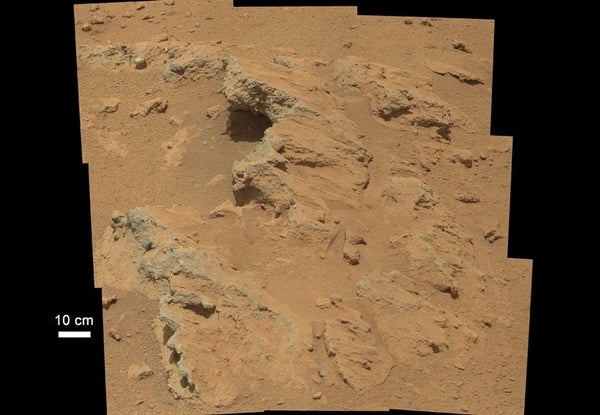
The rock pictured in the above mosaic from Mastcam 100, the rover's telephoto camera, shows evidence for a sedimentary makeup. "This rock is made up of round gravels [not visible in this image] in a matrix that is very sand-rich," said co-investigator Rebecca Williams of the Planetary Science Institute in Tucson, Ariz. The gravel's round shape implies that it tumbled to its current location, but the pebbles are too large to be windblown. So the rock appears to have been deposited by flowing water sometime in Mars's past. "The consensus of the science team is that these are water-transported gravels in a vigorous stream," Williams added.
The rock outcrop, which has been named "Hottah" after Canada's Hottah Lake, has been disturbed since its formation, exposing the 10- to 15-centimeter-thick slab to view. "To us it just looked like someone came along the surface of Mars with a jackhammer and just lifted up the sidewalk," Curiosity project scientist John Grotzinger said. He added that the science team was still debating the possible cause for Hottah's exposure, but that the simplest explanation was the impact of a small meteorite that lifted the former gravel bed up out of the ground.
On supporting science journalism
If you're enjoying this article, consider supporting our award-winning journalism by subscribing. By purchasing a subscription you are helping to ensure the future of impactful stories about the discoveries and ideas shaping our world today.
—John Matson