
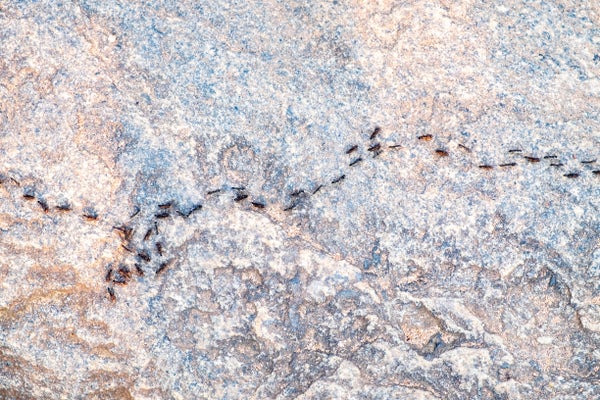
From an airplane, cars crawling down the highway look like ants. But actual ants—unlike cars—somehow manage to avoid the scourge of stop-and-go traffic. Researchers are now studying these insects’ cooperative tactics to learn how to program self-driving cars that don’t jam up.
The free flow of traffic becomes unstable as the density of cars increases on a highway. At 15 vehicles per mile per lane, one driver tapping their brakes can trigger a persistent wave of congestion. “It’s a kind of phase transition,” like water turning from a liquid to a solid form, says Katsuhiro Nishinari, a mathematical physicist at the University of Tokyo, who studies these jamming transitions.
Nishinari’s previous research had shown that foraging ants can maintain their flow even at high densities. So what’s their secret? In a recent study published in Transportation Research Interdisciplinary Perspectives, researchers recorded Ochetellus ants on foraging trails and used traffic-engineering models to analyze their movement. They found that the ants don’t jam because they travel in groups of three to 20 that move at nearly constant rates while keeping good distances between one another—and they don’t speed up to pass others.
On supporting science journalism
If you're enjoying this article, consider supporting our award-winning journalism by subscribing. By purchasing a subscription you are helping to ensure the future of impactful stories about the discoveries and ideas shaping our world today.
Human drivers at rush hour are hardly inclined to follow such rules. “We’re maximizing the interests of individuals, [which] is why, at a given point, you start to have a traffic jam,” says study co-author Nicola Pugno, who studies solid mechanics at the University of Trento in Italy.* But self-driving cars, if they one day become ubiquitous, could have more cooperative programming. In one vision of this future, autonomous vehicles would share information with nearby cars to optimize traffic flow—perhaps, the researchers suggest, by prioritizing constant speeds and headways or by not passing others on the road.
This vehicle network would be analogous to ants on a trail, which use scent to coordinate behavior while interacting with one another. “There is no leader,” but this organization emerges anyway, says Noa Pinter-Wollman, a behavioral scientist currently studying ants at the University of California, Los Angeles. And in both ant and vehicle traffic, this type of distributed system can be “very, very strong” and resilient, Nishinari says. (Neither Nishinari nor Pinter-Wollman was involved in the new research.)
Still, ants can do a lot of things that cars—even self-driving ones—can’t, Pinter-Wollman points out. Ants can forge trails as wide as they like, unlike drivers stuck on highways. The insects do sometimes jam up when confined in tunnels, but to keep things moving, “they’ll find a way to walk on the ceiling,” she says. Plus, unlike cars, ants don’t crash; they can literally walk over one another.
Today’s drivers can learn at least one thing from ants to avoid causing a traffic jam, Nishinari says: don’t tailgate. By leaving room between their car and the one ahead of them, drivers can absorb a wave of braking in dense traffic conditions that would otherwise be amplified into a full-blown “phantom” traffic jam with no obvious cause. “Just keeping away,” he says, can help traffic flow smoothly.
*Editor’s Note (3/12/25): This sentence was edited after posting to correct Nicola Pugno's field of study.