
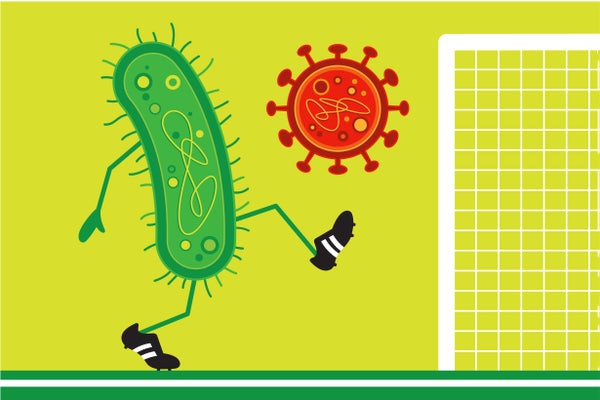
The idea that a single-celled bacterium can defend itself against viruses in a similar way as the 1.8-trillion-cell human immune system is still “mind-blowing” for molecular biologist Joshua W. Modell of Johns Hopkins University.
Scientists discovered about 20 years ago that bacteria employ an adaptive defense system called CRISPR, which lets microbes recognize and destroy viral invaders on repeat encounters. In a recent study published in Cell Host & Microbe, Modell and his team deepened scientists’ understanding of how bacteria use this system to “vaccinate” themselves against phages, the viruses that try to kill them. The findings could help develop treatments to fight antimicrobial resistance, which contributes to millions of deaths annually.
The CRISPR system allows bacteria to edit their own genetic code. After being exposed to a virus, a bacterium can use a special enzyme to create openings where it can insert small pieces of the virus’s DNA, called spacers, into its own genome, which helps it recognize and fight off the virus next time. Scientists have used this enzyme as a pair of “genetic scissors” to tweak DNA in everything from laboratory experiments to gene therapies, but researchers still knew little about how this process plays out in bacteria. “We called it the CRISPR mystery because we didn’t really understand what was happening inside,” Modell says.
On supporting science journalism
If you're enjoying this article, consider supporting our award-winning journalism by subscribing. By purchasing a subscription you are helping to ensure the future of impactful stories about the discoveries and ideas shaping our world today.
To understand how bacteria manage to grab the DNA of invading viruses, the researchers ran controlled lab experiments using Streptococcus pyogenes bacteria and the phages that infect it. During the infectious phase, most phages rupture the cell immediately in a process known as lysis. On other occasions viruses instead hide inside the bacterial DNA and become dormant, a state called lysogeny that is notoriously difficult to study.
In the lab, Modell’s team infected some bacteria with phages that could go dormant and others with genetically engineered phages locked in an active state. The scientists then collected surviving cells and checked their genetic code to see whether they had added new spacers taken from the viruses’ DNA.
The researchers found that bacteria added more spacers from phages that could go dormant. During this lull, Modell explains, the bacteria have time to grab tiny pieces of viral DNA and store them in their genome: “The CRISPR system makes memories against an inactivated form of the virus just like a vaccine.”
To confirm their results, Modell and his team exposed spacer-carrying bacteria to the same phages again to determine whether the new genetic memories protected them from infection. The researchers observed that S. pyogenes can recognize the phages using those stored fragments and fight them off.
The findings are “pretty remarkable,” says microbiologist Stan Brouns of Delft University of Technology in the Netherlands, who was not involved in the study. Understanding the interactions between phages and bacteria is key to improving phage therapies, in which scientists use viruses to treat infections caused by bacteria that have developed resistance to antibiotics.
This new understanding could also help researchers design phages to which more types of infection-causing bacteria will be susceptible, says North Carolina State University molecular biologist Rodolphe Barrangou, who co-founded phage therapy company Locus Biosciences and was not involved in the study. Various bacteria can have any of more than 150 antiphage defense mechanisms that treatments have to dodge; understanding how this one works, Barrangou says, is “going to inspire people who work on [bacteria] to think about phage therapies on a broader range of infectious diseases.”