
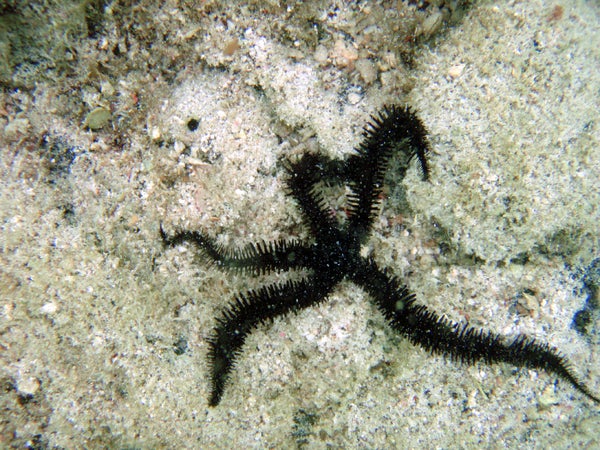

Seeing doesn’t always take eyes. The brittlestar Ophiocoma wendtii, a relative of starfish, can scan the sea floor, thanks to light-sensitive cells scattered across its skin, rather than by using eye-like structures, a study suggests.
The research, published on January 24 in Proceedings of the Royal Society B, upends a long-standing hypothesis about how Ophiocoma sees its surroundings.
Although it has no brain, this reef-dwelling animal—consisting of five arms joined to a central disk—can detect light and move away from it. Ophiocoma’s skeleton, which is draped in a thin layer of skin, is covered in bead-like crystal structures, which scientists thought worked together as a big compound eye. By focusing light onto nerve bundles that researchers thought ran below these 'microlenses', the arrangement would allow the animal to form an image.
On supporting science journalism
If you're enjoying this article, consider supporting our award-winning journalism by subscribing. By purchasing a subscription you are helping to ensure the future of impactful stories about the discoveries and ideas shaping our world today.
But when a team of evolutionary biologists took a closer look at the brittlestar’s skeleton, they realized that the tiny crystal structures probably had nothing to do with vision. The latest study offers “striking evidence” that contradicts this previous interpretation, says zoologist Gordon Hendler of the Natural History Museum of Los Angeles County, California, one of the first scientists to come up with the idea of a compound eye in Ophiocoma.
“It’s a good example of how nature surprises us,” adds Todd Oakley, an evolutionary biologist at the University of California, Santa Barbara, who wasn’t involved in the research. “Sometimes, the closer we look, the more unexpected things we find.”
Skin deep
The researchers first confirmed that Ophiocoma could respond to visual cues. “Not only do they move away from light, but they can pick out a dark shade at a distance of about 40 centimetres and move towards it very rapidly,” says neurobiologist Lauren Sumner-Rooney at the University of Oxford, UK, who led the study.
When the team peered into the brittlestar’s body, they saw that the nerve bundles ran between, rather than below, the crystal structures—contrary to what they expected. Because of the crystal structures’ location, it’s unlikely that they can focus light onto the nerves, as previously thought, Sumner-Rooney says.
What’s more, the researchers spotted plenty of cells packed with light-sensitive molecules in the skin covering the skeleton of the brittlestar’s arms, but no such cells at the base of the skeletal crystal structures. Because these light-sensitive cells are in close contact with nerve bundles, they might be the ones responsible for detecting visual cues and sending the signal along the nerves, Sumner-Rooney says.
Exactly how the nerves produce a response, such as moving an arm away from light, is still unclear, says Elizabeth Clark, an evolutionary biologist at Yale University in New Haven, Connecticut.
A larger question is whether the brittlestars can resolve shapes. The researchers are conducting ongoing experiments that suggest they can, similar to animals equipped with eyes, Sumner-Rooney says.
Look, no eyes!
“There’s a growing understanding that the ability to see without eyes or eye-like structures, called extraocular photoreception, is more widespread than we thought,” says Julia Sigwart, an evolutionary biologist at Queen’s University Belfast, UK, and a study co-author. Many animals, including sea urchins and some small crustaceans, use this mechanism to sense their surroundings. Brittlestars are just the latest addition to the list.
“Sensing the environment and responding to a stimulus without having to wait for that signal to go all the way to the brain can save a lot of time,” Sigwart says. And the idea could inspire the development of robots and image-recognition technology that don't rely on a central control system, she adds.
As for the crystal structures that researchers thought acted as microlenses, “they’re just part of the skeleton,” Sigwart says. Their transparency and ability to focus light is “completely coincidental”, she adds.
But Hendler disagrees. “They could still conduct light into the skeleton,” he says. “I’m not ruling out the possibility that they have some optical function.”
This article is reproduced with permission and was first published on January 24, 2018.