
You’ve no doubt seen this kind of news headline: “Astronomers Say Space Rock May Hit Earth in the Not-Too-Distant Future!” We usually get such warnings about one or two objects every year; the latest iteration concerns an asteroid, 2024 YR4, that is estimated to be more than 50 meters wide. For a while there was a several percent chance of its impacting Earth, but after more observations, by the end of February 2025 an impact had essentially been ruled out.
But how can anyone know such things? How do astronomers find these asteroids and then determine where they’ll be many years into the future?
We’ve actually known how to do this for centuries thanks to German astronomer Johannes Kepler, who first figured out the requisite orbital laws in the 17th century. Since that time, the advent of better telescopes, digital cameras and fast computers has made the task much easier—though by no means foolproof.
On supporting science journalism
If you're enjoying this article, consider supporting our award-winning journalism by subscribing. By purchasing a subscription you are helping to ensure the future of impactful stories about the discoveries and ideas shaping our world today.
There are around a dozen currently operating survey-type telescopic observatories that take wide-angle images of the sky every night and look for undiscovered objects zipping through our solar system. Seen from Earth, such objects appear to move relative to the far more distant “fixed” stars. Astronomers used to look for such motions by eye with photographs, but automation can now perform this task far faster and more accurately.
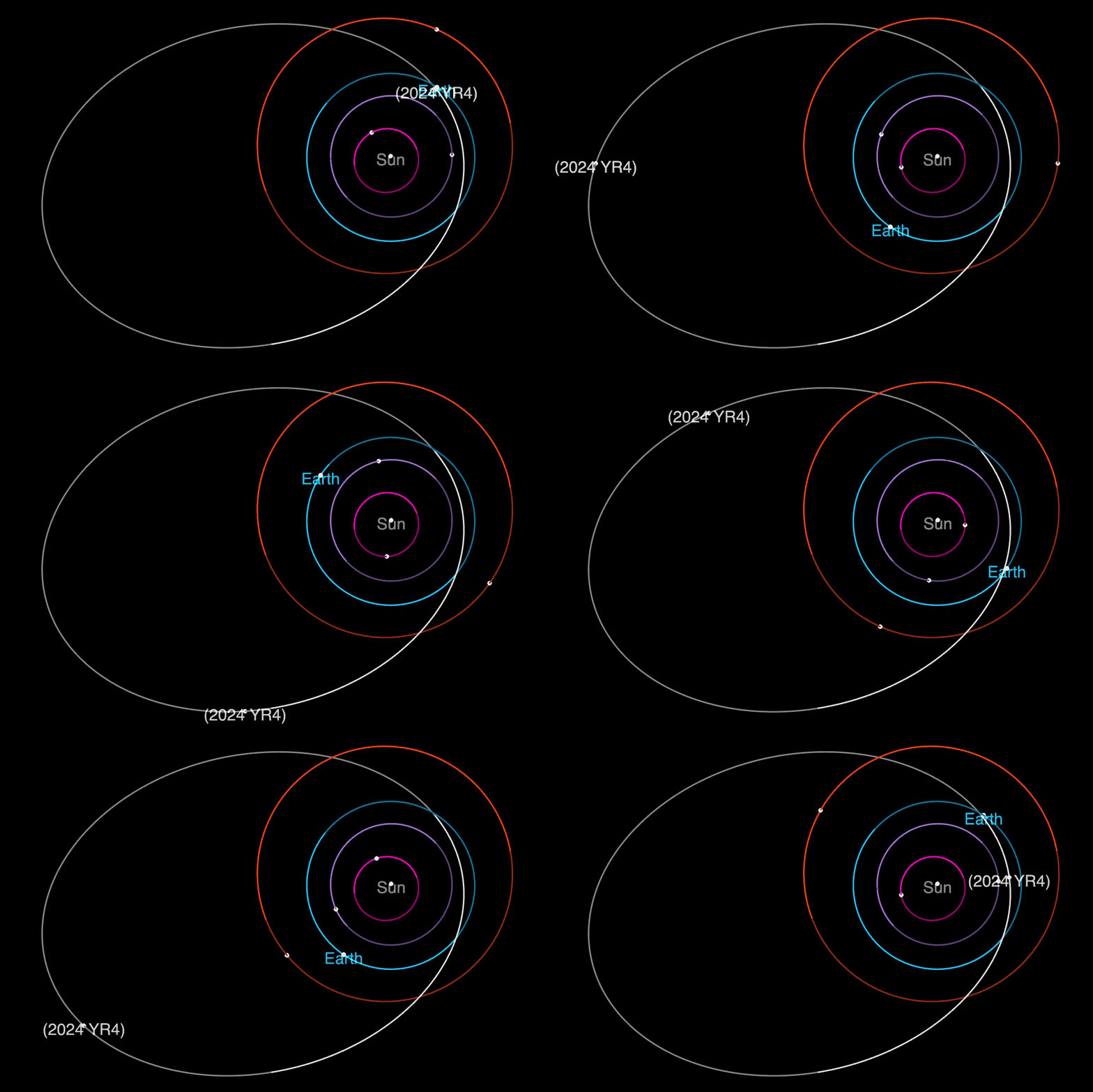
The predicted orbit of the asteroid 2024 YR4 as animated in 3-month intervals per frame, beginning on December 22, 2024 and ending on December 22, 2032.
NASA/JPL-Caltech
Once a new moving object is found, its orbit needs to be determined. Is it on a circular path out past Mars, or does it have an elliptical orbit that brings it close to Earth? This is where Kepler and his laws come in.
He figured out that all orbits have one of three shapes: elliptical, parabolic or hyperbolic. (A circle is just an ellipse where the long and short axes are equal, so we lump circles in with ellipses.) Parabolic and hyperbolic orbits are what we call “open,” meaning they don’t close back on themselves. An object on an orbit like that is just passing through; it’s moving rapidly enough to escape the sun’s gravity and disappear into interstellar space. Most comets that fall in toward the sun from beyond Neptune have nearly parabolic orbits. Only two objects have ever been found on extremely hyperbolic orbits: ‘Oumuamua and the comet 2I/Borisov.
But an object on an elliptical orbit is bound to the sun and should orbit it indefinitely (unless it gets a gravitational kick from a planet, say). Our ability to predict a sun-orbiting object’s future position comes from understanding everything we can about its ellipse.
We must keep our eyes on the sky. The good news is that even more telescopes are coming online, including the huge Vera C. Rubin Observatory in Chile and NASA’s NEO Surveyor.
The basic characteristics of an orbital ellipse are its size (mathematically, half the length of its long axis, a measurement called the semimajor axis), its eccentricity (which essentially measures how elliptical it is: 0 is circular, and 1 is infinitely stretched out, like a line), and its orientation in space. An object’s orbital ellipse can be tipped relative to that of Earth, for example, with its long axis pointed in some particular direction in space. Once we know all those parameters (called the orbital elements), we can mathematically define the associated ellipse. If we also know an asteroid’s position along its ellipse, say, on the date it was discovered or at a specific time during a subsequent observation, Kepler’s equations tell us where along its orbit the asteroid should be on any given day—well, in theory.
In practice, it’s not so easy. Forecasters usually need at least three well-separated observations of an asteroid to start nailing down all the variables governing the ellipse’s shape. And those observations are not exact: asteroids don’t look like perfect tiny dots in an image but instead are smeared out a bit, making it hard to know their precise position as they shift against the background stars.
Such imprecisions may be small, but they add up. Thus, the result usually isn’t an ideal ellipse, and the calculated path of the asteroid is fuzzy; in reality, its position might be a bit off from the predicted location. The further into the future (or past, for that matter) you try to calculate the position, the worse the prediction gets. It’s like the actual path of the asteroid is a cone with its vertex at the present position, opening up toward the direction in which you’re trying to make predictions. Statistically speaking, the rock could be anywhere inside that cone, and that can add up to a large volume of space.
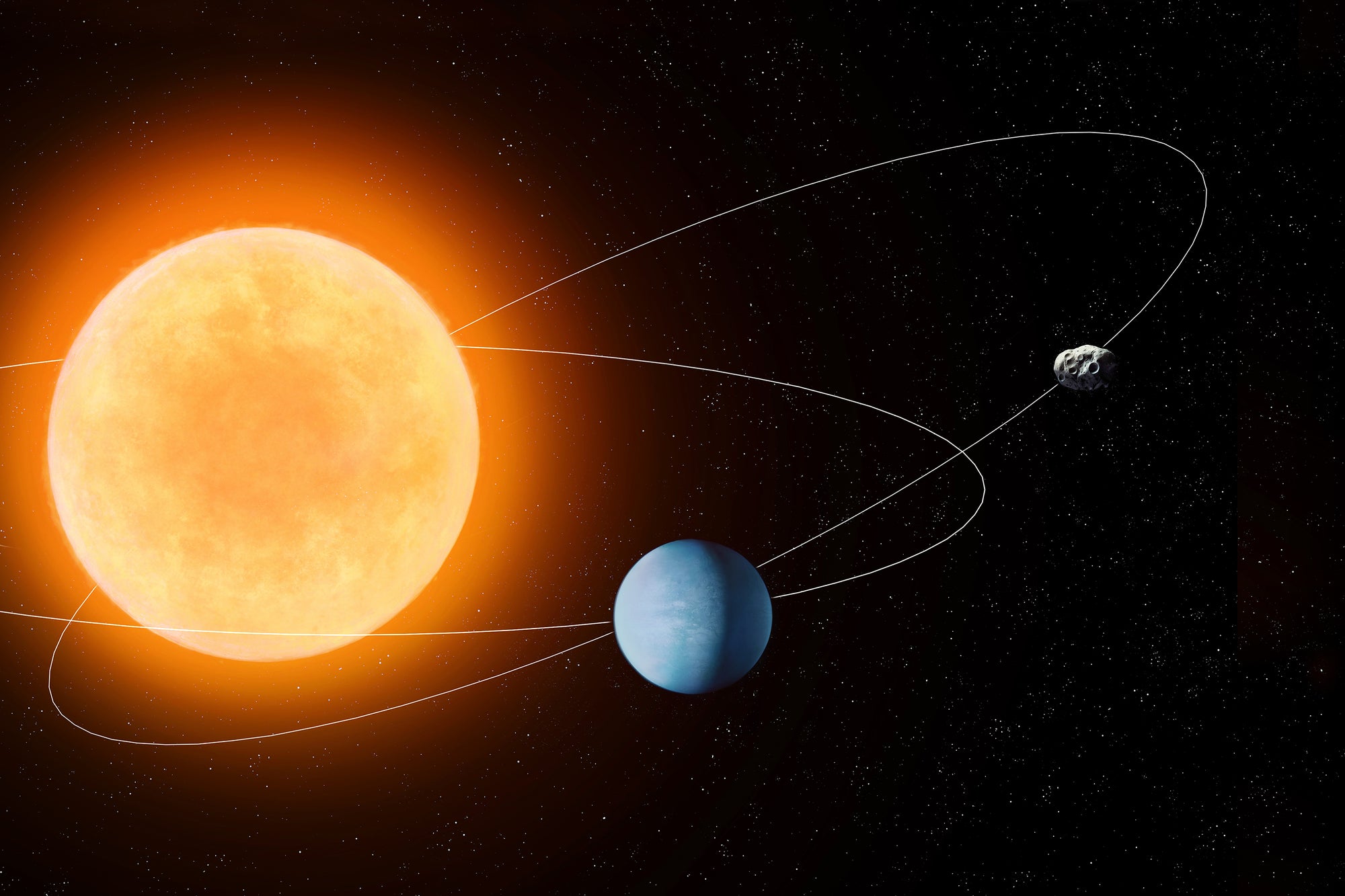
A not-to-scale illustration of an asteroid’s orbital path crossing the orbit of Earth around the sun.
Nazarii Neshcherenskyi/Getty Images
The only way to narrow that path down is to get more observations, either fresh from telescopes or retroactively found in archival data. Also, the longer an object is observed, the more certain its orbital-element measurements become.
It’s like being an outfielder in a baseball game. Imagine the pitcher throws the ball, but one second after the batter hits it, you have to close your eyes and guess where it will be so you can catch it. You can make a decent estimation, but it won’t be anywhere near accurate enough to guide you. You must be able to keep your eye on the ball and watch as it moves to maximize your chances of making the catch.
So we aim to observe asteroids for as long as possible to increase the temporal baseline of observations. There are obstacles, though: some asteroids are small and decrease in brightness rapidly as the distance between them and Earth increases. This is the case for 2024 YR4, which is now moving away from Earth and forecasted to fade from view in late April. Asteroids can also avoid observation by getting so close to the sun in the sky that they can’t be seen for several months.
Assuming, however, that an asteroid’s orbit is well constrained and predictable, how do we know what the odds are of an Earth impact? There are many methods for calculating this likelihood; one way is to simulate the orbit and note the dates when the object is in Earth’s orbital vicinity, then determine whether our planet will be in its path at the same time. If so, well, that’s bad.
But not necessarily catastrophic. Earth is a small target, and the statistical volume of space the asteroid can be in on that date is usually large. Even for an apparently alarming asteroid, there’s only a chance we’ll get hit, and it’s usually very low, especially the further in advance we try to predict it. Typically the odds of impact for any newfound potentially Earth-threatening space rock are one in thousands.
In most cases, better observations nail down the path and show that it passes well away from Earth, and the odds drop effectively to zero. Irritatingly, the statistical chance of impact sometimes increases first—which is what happened with 2024 YR4. Remember, the asteroid is somewhere near the vertex of a large cone, and we don’t know where. If Earth is near the cone’s centerline, then as the cone narrows with better observations, we’re still inside it. The chance of impact goes up. But then, almost always, the cone narrows further and winds up pointing in a slightly different direction, leaving Earth safely outside it, and we can all breathe a sigh of relief.
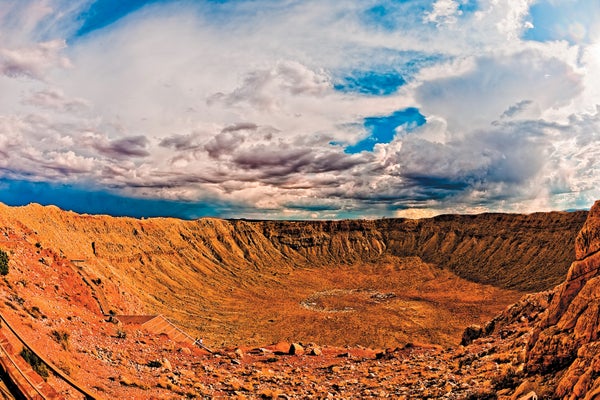
That’s not to say we never get hit! Examples abound, such as the Chelyabinsk asteroid that exploded over Russia in 2013, the Tunguska event in Siberia in 1908 and the impact that formed Arizona’s Meteor Crater 50,000 years ago. Every day Earth plows through roughly 100 tons of interplanetary material, the vast majority of which is composed of tiny rocks that wind up as lovely meteors streaking across our sky. But sometimes those chunks of debris are bigger—much bigger. The bigger they get, the rarer they become, so truly devastating impacts are few and far between.
They do happen, though, so we must keep our eyes on the sky. The good news is that even more telescopes are coming online, including the huge Vera C. Rubin Observatory in Chile and NASA’s NEO Surveyor (planned for launch in 2027), and they should help us not just map where these objects are and where they’re headed but also determine their size and what they’re made of. If some asteroid big enough to do damage has us in its crosshairs, we hope we’ll know about it as soon as we can, giving us enough time, perhaps, to do something about it.
The more telescopes we have covering the greatest amount of sky over time, the better.