If you're enjoying this article, consider supporting our award-winning journalism by subscribing. By purchasing a subscription you are helping to ensure the future of impactful stories about the discoveries and ideas shaping our world today.
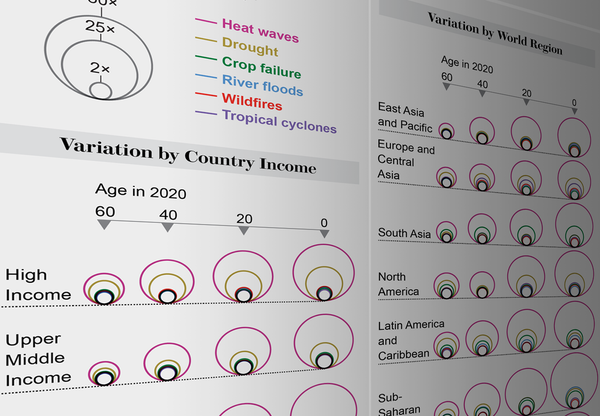
Babies born today will experience far more disruptions fueled by climate change than their parents or grandparents. In a study published in October 2021 Science, Wim Thiery of Vrije Universiteit Brussel in Belgium and his colleagues combined climate model projections under three global warming scenarios with demography data to calculate the lifetime exposure to six types of extreme weather for every generation born between 1960 and 2020. Even as a climate scientist acutely aware of the dangers of rising temperatures, “seeing the numbers as a person, as a parent, is a punch in the stomach,” he says. Young people in the Middle East and sub-Saharan Africa and those in low-income countries will see the largest increases in exposure. These estimates examine only changes in the frequency of extreme events—they do not represent how those events may become more intense and longer-lived. Although “young generations have the most to lose if global warming reaches higher levels,” Thiery says, they also have the most to gain if greenhouse gas emissions can be reined in. “That is a key message of hope.”
Credit: Amanda Montañez; Source: “Intergenerational Inequities in Exposure to Climate Extremes,” by Wim Thiery et al., in Science, Vol. 374; October 8, 2021 (data)
Subscribe to Support Independent Journalism
Great science journalism requires human expertise, time, effort and creativity. And it costs money. That’s why I and the journalists here at Scientific American hope you’ll join our community.
When you subscribe, you are supporting staff and freelance journalists who are passionate about telling science stories that are true, important and compelling. Our editors and reporters are often experts in their fields, which means they understand the nuances of big discoveries and can untangle the breakthroughs from the hype. With a subscription, you are also supporting rigorous fact-checking to ensure the words we publish are precise and accurate. And you’re supporting original illustrations, graphics and photos that bring you closer to an advanced laboratory, an ice sheet in Antarctica or a space mission in orbit. You’re helping us craft other types of high-quality journalism as well: Our newsletters are carefully written, edited and curated by staffers you have or will come to know and love. Our Science Quickly podcast is based on original reporting, collaboration with editors and scientists and exacting production.
Subscriptions keep this engine running so we can continue to deliver thoughtful, rigorous and independent science journalism to you. In an era of viral misinformation, this work is crucial. If you value what we do, I hope you’ll consider joining us as a subscriber
Thank you,
Jeanna Bryner, Editor in Chief, Scientific American