
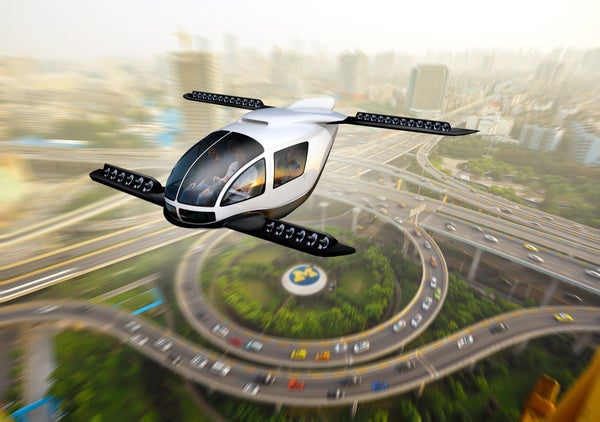
Flying cars may sound like something out of a sci-fi movie, but they could help fight climate change, according to a novel new study.
NASA and several companies — including Boeing Co. and Airbus SE — are racing to develop electric versions of flying cars. The technology is roughly five years away from demonstration and 10 years away from deployment.
Once they become a reality, flying electric cars will produce far fewer greenhouse gas emissions than traditional cars in certain applications, according to the study from the University of Michigan and Ford Motor Co.
On supporting science journalism
If you're enjoying this article, consider supporting our award-winning journalism by subscribing. By purchasing a subscription you are helping to ensure the future of impactful stories about the discoveries and ideas shaping our world today.
In particular, flying electric cars will be a far more sustainable option when fully loaded with passengers and when traveling over long distances, according to the study, which was published Tuesday in the journal Nature Communications.
The design of flying electric cars — known formally as electric vertical takeoff and landing aircraft, or VTOLs — varies widely by company. But in general, they resemble a cross between a car and an airplane with two or more electric propellers. Some may fly up to speeds of 150 mph.
Using publicly available data from companies, the researchers compared the energy use and emissions of flying electric cars to traditional cars. They found that flying electric cars would have 35% lower greenhouse gas emissions than traditional cars when carrying one pilot for 100 kilometers, or about 62 miles.
The flying electric cars fared even better when fully loaded with a pilot and three passengers for a trip of the same distance. In that scenario, they would have 52% lower greenhouse gas emissions than traditional cars.
Still, the flying electric cars fared worse in comparison with battery-electric vehicles. They would have 38% higher greenhouse gas emissions than electric vehicles when carrying one pilot, and just 6% lower emissions than electric vehicles when carrying a pilot and three passengers.
In terms of efficiency, the researchers found that flying electric cars use significant energy to take off and land, but they're highly efficient when cruising. That means they're most efficient overall on longer trips.
Gregory Keoleian, a co-author of the study and director of the University of Michigan's Center for Sustainable Systems, said he grew up watching "The Jetsons," the animated sitcom depicting a future with elaborate contraptions and inventions.
"I did grow up watching 'The Jetsons,' and to think that 50 years later we did an analysis of the technology is quite exciting," he said.
Keoleian said his team concluded that the best application of flying electric cars would be an aerial taxi service that carried multiple passengers over long distances. Such a service could replace car trips in areas with heavy congestion or circuitous routes.
As an example, Keoleian cited the car trip from Detroit to Cleveland. In addition to bottlenecks, the route features a winding path around Lake Erie.
Ultimately, Keoleian said that new technologies like flying electric cars could help decarbonize the transportation sector, which recently surpassed the power sector as the country's largest source of planet-warming emissions.
"We are in a carbon-constrained world," he said. "We gotta ensure that investments and policy encourage the fastest pathways to efficiency and lower carbon emissions. So I'm excited to study a technology like this."
Reprinted from Climatewire with permission from E&E News. E&E provides daily coverage of essential energy and environmental news at www.eenews.net.