
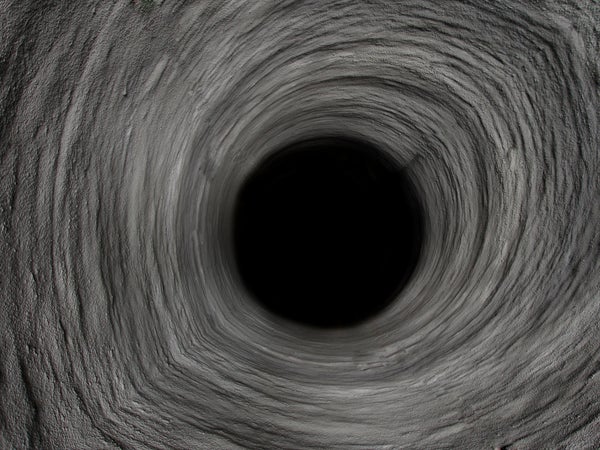

A portal to the center of the earth sits among the ruins of an abandoned project site in Murmansk, Russia, not far from the Norwegian border. Sure, it’s covered and welded shut, but it still sounds like a horror film to me. The deepest hole ever dug may be pretty unassuming, but I suspect I’m not alone in being a little freaked out by it. An internet search about the world’s deepest hole turns up the suggestion "Kola Superdeep Borehole screams." No wonder locals call it the well to hell.
Before the very idea of a superdeep hole starts haunting your dreams, keep this in mind—the hole is only nine inches in diameter (that’s about 23 centimeters). There’s no way you could fall into it.
On supporting science journalism
If you're enjoying this article, consider supporting our award-winning journalism by subscribing. By purchasing a subscription you are helping to ensure the future of impactful stories about the discoveries and ideas shaping our world today.
How deep is the deepest hole?
Known as the Kola Superdeep Borehole, the deepest hole ever dug reaches approximately 7.5 miles below the Earth’s surface (or 12,262 meters), a depth that took about 20 years to reach.*
The hole was intended to go “as deep as possible,” which researches expected to be around 9 miles (that’s ~14,500 meters). But the scientists and engineers were forced to give up when they hit unexpectedly high temperatures. At 7.5 miles below the surface, the 2.7 billion year old rocks there at temperatures of around 180 degrees Celsius (or a scorching 356 degrees Fahrenheit). This was almost twice as hot as they’d predicted.
Such high temperatures deform the drill bits and pipes. The rocks themselves also become more malleable. The Russian scientists in Kola described the rocks at those depths as behaving more like plastic than rock.
Since the drilling was stopped in 1992, and the project site was abandoned around a decade later, the Kola Superdeep Borehole has maintained the record for the deepest artificial point on Earth. Humans have since dug longer boreholes, including the 12,289-meter borehole drilled in the Al Shaheen Oil Field in Qatar and the 12,345-meter offshore oil well near the Russian island of Sakhalin. But the hole in Kola remains the deepest.
Why do we dig deep holes?
There are a few reasons we humans dig deep into the Earth—extracting resources like fossil fuels and metals, for starters. A 100-year-old copper mine in the mountains near Salt Lake City, Utah hosts a pit that extends three quarters of a mile deep and spans 2.5 miles. At 215 meters, the Kimberley Diamond Mine in South Africa is one of the largest holes in the world dug by human hands.
We also dig, of course, for science. Experiments looking for neutrinos, nearly massless subatomic particles that get produced in explosive astronomical events like exploding stars and gamma-ray bursts, have to put their detectors far below the Earth’s surface. That’s the case for the University of Wisconsin’s IceCube Neutrino Observatory in Antarctica. These depths are needed to pick out the faint signal of the neutrinos from the stronger background radiation at the Earth’s surface. In the case of IceCube, their experiments run as far down as 1.5 miles via holes “dug” by pouring tens of thousands of pounds of hot water to melt the ice.
Drilling the Kola Superdeep Borehole was, for the most part, purely science-driven. Soviet scientists wanted to learn more about our planet’s outermost layer, called the crust, to understand how that crust has formed and how it evolved. Now, I say “for the most part” because people have likened efforts to dig the deepest hole to the space race. Science was the goal, but everyone wanted bragging rights for winning the race to the center of the Earth.
An American effort, known as Project Mohole, attempted to drill deep into the floor of the Pacific Ocean off the coast of Mexico in 1958. The project’s goal was to reach the boundary where the Earth’s crust meets the next layer, called the mantle. Congress discontinued funding in 1966 when the drillers had reached only 183 meters (or a tenth of a mile).
In the early 90s, German scientists reached about 6 miles below the surface in Bavaria with the German Continental Deep Drilling Program. There, they hit seismic plates and found temperatures of 600 degrees Fahrenheit. Due to lack of funds, that project was also abandoned.
The Japanese drillship Chikyu has drilled almost 2 miles into the ocean floor, the deepest we’ve dug in the ocean for science. BP’s Deepwater Horizon, which was lost in the infamous explosion and oil spill in 2010, holds the overall record for deepest offshore hole at about 5 miles below the sea floor.
»Continue reading “How Deep is the Deepest Hole in the World?” on QuickAndDirtyTips.com
*Editor’s Note (3/23/21): This sentence was revised after posting to correct the metric figure for the depth of the Kola Superdeep Borehole.