
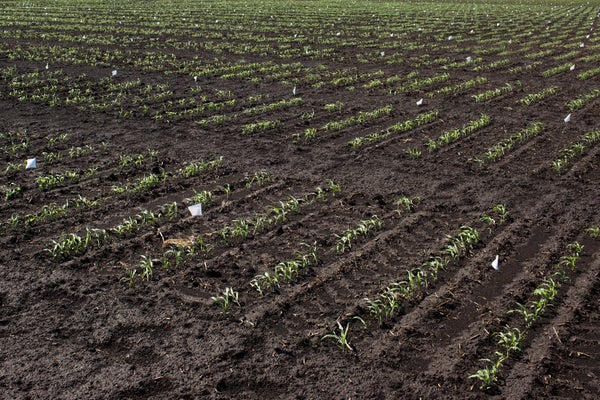
Soil management doesn't sound snazzy, but scientists say it offers huge potential for keeping carbon emissions in the ground—and out of the atmosphere.
A paper published this week in the journal Scientific Reports estimates that improved land-use practices could increase the amount of carbon stored in the top layer of soils worldwide by between 0.9 and 1.85 billion metric tons each year.
At the high end, that's about as much carbon as is emitted by the transportation sector annually, the researchers note.
On supporting science journalism
If you're enjoying this article, consider supporting our award-winning journalism by subscribing. By purchasing a subscription you are helping to ensure the future of impactful stories about the discoveries and ideas shaping our world today.
Protecting and expanding the world's carbon sinks—including the ocean, the soil, global forests and other types of vegetation, all of which naturally store away carbon that would otherwise go into the atmosphere—is increasingly regarded by scientists as a major climate change mitigation tool. Worldwide, scientists estimate that the planet's soil alone contains about 2.5 trillion tons of carbon in its top 3-foot layer. That's about 250 times more carbon than is emitted into the atmosphere by humans each year.
Human activities, such as converting land for agriculture, have the potential to seriously disturb the soil and release large amounts of carbon into the atmosphere. In fact, one recent study suggested that agriculture-related changes of land use over the last 12,000 years of human history have released about 133 billion tons of carbon into the air, equivalent to about 13 years of present-day fossil fuel emissions. And the majority of those soil-related emissions have likely occurred in the last few centuries alone.
But scientists now increasingly suggest that improving soil health, through practices such as rotating crops or composting, can increase its carbon-storing potential. This week's paper uses information from global soil and land-cover databases to investigate how much more carbon might be sequestered in locations around the world under improved land management practices, building on previous research published in 2014.
Storage potential differs region by region, the researchers note. North America has the highest potential for total amount of carbon storage over all the land available, although parts of South Asia and North Africa have the greatest potential for storage on a per-hectare basis.
"Regenerating soil organic carbon is a foundational strategy for conservation, through which we can provide food and water sustainably and help tackle climate change," Deborah Bossio, lead soil scientist at the Nature Conservancy and one of the study's authors, said in a statement. "Analyses like this help us understand the importance of soil management for reaching climate goals. The question now is: how can we unlock this potential?"
The answer to that question may still be somewhat controversial. While scientists now broadly agree that changes in land management and agricultural practices may improve the ground's carbon-storing potential, how and even whether to do so remains a topic of discussion among policymakers.
"It's just not a high priority in terms of all the issues faced globally by agriculture," said Jonathan Sanderman, a soil expert at the Woods Hole Research Center in Massachusetts, who was not involved with the new study.
Not on the Bonn agenda
Indeed, as the U.N. climate conference draws to a close in Bonn, Germany, this week, Sanderman noted that soil carbon sequestration as a climate mitigation tool has still not made it to the official agenda, although it's been heavily touted in side events by environmental groups and other organizations.
Particularly in discussions about agriculture in the developing world, issues related to improving food security, increasing crop yields and protecting agriculture against the effects of climate change are much higher on the agenda—not without reason, given that the world's population is projected to exceed 9 billion people by midcentury. And Sanderman noted that among policymakers he's spoken with, there's been "a lot of hesitation for really focusing on climate mitigation in improving agriculture in a developing world context, thinking it might go against a lot of sustainable development goals."
Still, experts have suggested that the two issues are hardly mutually exclusive. Improving soil health in ways that may increase crop yields can also naturally improve its carbon-storing potential, suggested Rolf Sommer of the International Center for Tropical Agriculture (CIAT) and one of the new study's authors.
"For us, food security and resilience to climate change comes first," Sommer said of CIAT as an organization. "And the beauty of carbon sequestration is if you improve your resource bases—your soil health, your soil fertility—it almost automatically comes with sequestration of carbon."
Sanderman cautioned that research should focus carefully on how, or whether, specific agricultural practices aimed at improving crop yields actually affect soil carbon storage potential. Sommer also noted that even implementing land use practices targeted at increasing carbon sequestration can take some time, a few years at least, to become effective—and their effects don't last forever, either. Soil can't continue to store more carbon indefinitely. Eventually the system reaches a new equilibrium, and "it would start leveling off at some point," Sommer said.
But research, including this week's paper, does increasingly suggest that the ground beneath our feet presents a hefty potential tool in the climate mitigation arsenal.
And it's not just improved agricultural practices that present natural climate mitigation opportunities. Improved land management, generally speaking, is increasingly touted by scientists and environmentalists as a key strategy in the fight against climate change. That includes more sustainable forest management, reforestation efforts and the conservation of key natural carbon sinks, such as wetlands and grasslands worldwide. These strategies focus not just on increasing the amount of carbon that can be stored in the landscape, but also on preventing valuable carbon sinks from disturbances that might cause them to unleash the massive amounts of carbon they already contain.
Such tactics may become important factors in helping policymakers meet local or global climate goals, research suggests. One paper, published this week in Proceedings of the National Academy of Sciences, suggested that improved ecosystem management and conservation—such as improving forest management and preventing natural landscapes from being converted for agriculture—may help California avoid as much as 147 million metric tons of carbon dioxide emissions by 2030, more than 17 percent of its greenhouse gas reduction goals. California maintains some of the most ambitious state-level climate goals in the nation.
Similar strategies could make a difference on a global scale as well. Another paper, published in PNAS just last month, suggested that these types of "natural climate solutions"—improving land management and avoiding additional emissions by conserving natural landscapes—can provide about a third of the climate mitigation activity needed to keep global warming within a 2-degree Celsius threshold by 2030 (Climatewire, Oct. 18).
And while soil carbon, particularly as it's linked to global agricultural practices, may remain an ongoing topic of discussion, the science suggests that it's a conversation worth continuing.
"There should be a focus on soil carbon," Sanderman said. "The numbers are big enough that they are globally significant. On their own, they're not going to solve our climate problem, but as we scale up, it can be a significant part of the solution."
Reprinted from Climatewire with permission from E&E News. E&E provides daily coverage of essential energy and environmental news at www.eenews.net.