
Alain Van Ryckegham, a professor at the School of Natural Resources at Sir Sandford Fleming College in Lindsay, Ontario, Canada, offers this explanation:
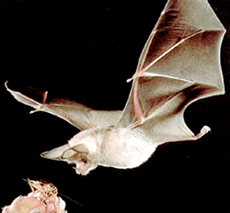
Image: Bioinfo Animal Pictures Archive
NIGHT HUNTER. This leaf-nosed bat uses sound waves and echoes--a technique called echolocation--to capture prey, such as crickets. |
Bats are a fascinating group of animals. They are one of the few mammals that can use sound to navigate--a trick called echolocation. Of the some 900 species of bats, more than half rely on echolocation to detect obstacles in flight, find their way into roosts and forage for food.
On supporting science journalism
If you're enjoying this article, consider supporting our award-winning journalism by subscribing. By purchasing a subscription you are helping to ensure the future of impactful stories about the discoveries and ideas shaping our world today.
Echolocation--the active use of sonar (SOund Navigation And Ranging) along with special morphological (physical features) and physiological adaptations--allows bats to "see" with sound. Most bats produce echolocation sounds by contracting their larynx (voice box). A few species, though, click their tongues. These sounds are generally emitted through the mouth, but Horseshoe bats (Rhinolophidae) and Old World leaf-nosed bats (Hipposideridae) emit their echolocation calls through their nostrils: there they have basal fleshy horseshoe or leaf-like structures that are well-adapted to function as megaphones.
Echolocation calls are usually ultrasonic--ranging in frequency from 20 to 200 kilohertz (kHz), whereas human hearing normally tops out at around 20 kHz. Even so, we can hear echolocation clicks from some bats, such as the Spotted bat (Euderma maculatum). These noises resemble the sounds made by hitting two round pebbles together. In general, echolocation calls are characterized by their frequency; their intensity in decibels (dB); and their duration in milliseconds (ms).
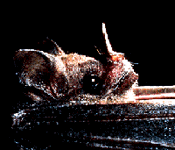
Image: Museum of Paleontology, UC Berkeley and Regents of the University of California.
MEGAPHONE NOSE. Some bats have specialized structures for emitting echolocation calls. |
In terms of pitch, bats produce echolocation calls with both constant frequencies (CF calls) and varying frequencies that are frequently modulated (FM calls). Most bats produce a complicated sequence of calls, combining CF and FM components. Although low frequency sound travels further than high-frequency sound, calls at higher frequencies give the bats more detailed information--such as size, range, position, speed and direction of a prey's flight. Thus, these sounds are used more often.
In terms of loudness, bats emit calls as low as 50 dB and as high as 120 dB, which is louder than a smoke detector 10 centimeters from your ear. That's not just loud, but damaging to human hearing. The Little brown bat (Myotis lucifugus) can emit such an intense sound. The good news is that because this call has an ultrasonic frequency, we are unable to hear it.

EEEKKK. Bat calls are categorized according to frequency, intensity and duration. Most sounds bats emit fall beyond the range of human hearing. |
The ears and brain cells in bats are especially tuned to the frequencies of the sounds they emit and the echoes that result. A concentration of receptor cells in their inner ear makes bats extremely sensitive to frequency changes: Some Horseshoe bats can detect differences as slight as .000l Khz. For bats to listen to the echoes of their original emissions and not be temporarily deafened by the intensity of their own calls, the middle ear muscle (called the stapedius) contracts to separate the three bones there--the malleus, incus and stapes, or hammer, anvil and stirrup--and reduce the hearing sensitivity. This contraction occurs about 6 ms before the larynx muscles (called the crycothyroid) begin to contract. The middle ear muscle relaxes 2 to 8 ms later. At this point, the ear is ready to receive the echo of an insect one meter away, which takes only 6 ms.
The external structure of bats' ears also plays an important role in receiving echoes. The large variation in sizes, shapes, folds and wrinkles are thought to aid in the reception and funneling of echoes and sounds emitted from prey. Echolocation is a highly technical and interesting tactic. To truly understand the concepts and complexity of this subject is to begin to understand the amazing nature of these animals. For interested readers, an excellent resource is M. Brock Fenton's book Bats.