
Since Monday at least 12 potentially explosive devices have been found in or intercepted on their way to the mailboxes of Democratic political leaders, prominent public figures and CNN’s New York City office. Authorities have now arrested Cesar Sayoc, 56, of Aventura, Fla., in connection with the bombs, according to news reports.
The packages found so far—whose intended recipients include former Pres. Barack Obama, presidential candidate Hillary Clinton and, most recently, New Jersey Sen. Cory Booker and former Director of National Intelligence James Clapper—looked dubious enough to be caught before they could cause harm. But they were just tape-bound, bubble wrap–lined manila envelopes. How do law enforcement officials determine whether a suspicious mailed package is a real threat?
Responders would typically not use sniffer dogs in an intercepted mail scenario like this week’s, says Marc Lamberty, a retired bomb squad technician who now works for the private security firm MSA Security. Especially if the package went through an x-ray machine in a mail-screening process and someone raised a flag based on what they saw inside. Dogs are typically used to find something hidden. “A dog is a [basic] search tool, and I’m above general search,” he says.
On supporting science journalism
If you're enjoying this article, consider supporting our award-winning journalism by subscribing. By purchasing a subscription you are helping to ensure the future of impactful stories about the discoveries and ideas shaping our world today.
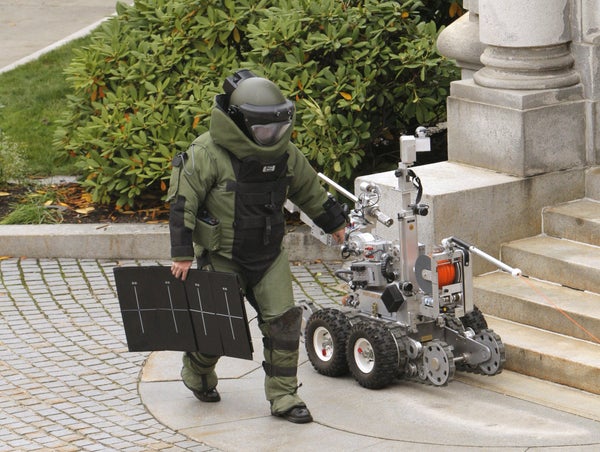
Standard protocol calls for an explosive ordnance disposal technician to thoroughly evaluate the package from the outside without touching it. Technicians in bomb suits can scan them up close. But, Lamberty says, “ideally, if you can work remotely, you will.” This means using a wirelessly controlled bomb-disposal robot to relay high-resolution images with its camera and manipulate the package with its mechanical arm. These bots can also be loaded with x-ray kits and other diagnostic tools.
You can glean a lot from an x-ray scan, says Jimmie Oxley, a chemistry professor and co-director of the University of Rhode Island’s Center of Excellence for Explosives, Detection, Mitigation and Response. X-ray images showed, for instance, that the packages mailed this week contained pipe bombs—devices that consist of explosive material in a pipe with a fuse. “There are 460 [bomb] squads in the U.S. and many of them, maybe all, use little x-ray machines to get an idea of what’s inside” a suspicious package, Oxley says. X-ray images can tell them how big the device is, reveal its components and understand its detonating circuitry so they do not accidentally trigger it.
Once investigators determine it is safe to open the package, they look for residues of chemical explosives on the pipe bomb or other device. They use technologies similar to the ones used for airport security screening. Colorimetric kits are a common tool used to detect tiny traces of explosive, Oxley says. These handheld kits come preloaded with different chemicals. When a swab of the suspicious device is placed on the kit, chemical reactions cause a color change that indicate the presence of common explosives.
If there is enough residue, Oxley adds, swabs can be run through an ion mobility spectrometer, or ion scanner—the same machine Transportation Security Administration agents use to analyze wet-swabs of people’s hands. These give a more detailed analysis of the explosive’s chemical composition. Other tools to identify chemicals include Raman spectroscopy and infrared spectroscopy, techniques that detect the telltale vibrations of molecules. Responders also carry radiological detectors to make sure there are no nuclear weapons involved, she adds.
Using all of this information, bomb technicians try to render the explosive safe so that it can be disassembled and analyzed for evidence. The device may carry fingerprints and DNA from the person who sent it. Investigators can also try to track where the chemicals and components were purchased. Sometimes technicians decide to detonate the device in a safe, controlled way, or it can accidentally explode. But even then, there is evidence to be found in the remaining bits and pieces. “Detonation doesn’t obliterate everything,” Oxley says. Bits of metal or plastic, shards of glass and a grain of chemical powder left behind can help technicians piece together how the bomb was made. Or it could yield a precious fingerprint.