
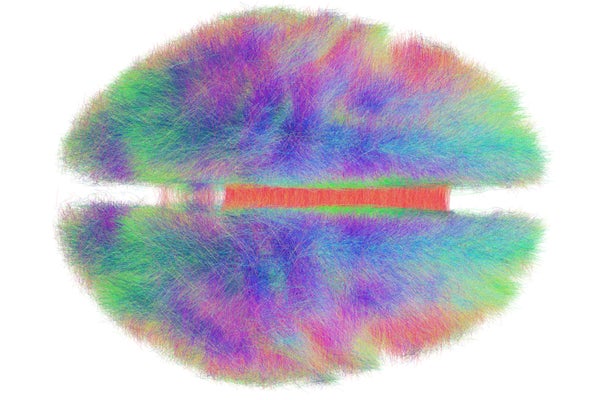

The human brain is an extraordinarily complex network, comprising an estimated 86 billion neurons connected by 100 trillion synapses. A connectome is a comprehensive map of these links—a wiring diagram of the brain.
With current technology, it is not possible to map a network of this size at the level of every neuron and synapse. Instead researchers use techniques such as magnetic resonance imaging to map connections between areas of the human brain that span several millimeters and contain many thousands of neurons.
At this macroscopic scale, each area comprises a specialized population of neurons that work together to perform particular functions that contribute to cognition. For example, different parts of your visual cortex contain cells that process specific types of information, such as the orientation of a line and the direction in which it moves. Separate brain regions process information from your other senses, such as sound, smell and touch, and other areas control your movements, regulate your emotional responses, and so on.
On supporting science journalism
If you're enjoying this article, consider supporting our award-winning journalism by subscribing. By purchasing a subscription you are helping to ensure the future of impactful stories about the discoveries and ideas shaping our world today.
These specialized functions are not processed in isolation but are integrated to provide a unitary and coherent experience of the world. This integration is hypothesized to occur when different populations of cells synchronize their activity. The fiber bundles that connect different parts of the brain—the wires of the connectome—provide the substrate for this communication. These connections ensure that brain activity unfolds through time as a rhythmic symphony rather than a disordered cacophony.
If brain wiring helps to coordinate neuronal activity, do people with different wiring patterns show differences in cognitive abilities? Some studies have shown that those with patterns of brain wiring that are particularly efficient at integrating information perform better on tests of general intelligence, whereas those diagnosed with disorders that affect cognition, such as schizophrenia, often have less efficient wiring patterns. Damage to regions of the brain that are highly connected to others may result in especially severe cognitive impairments. These findings indicate that patterns of brain-network wiring do indeed contribute to cognition.
Brain structure does not completely determine brain function, however. If this were true, our brains would be trapped in an endless cycle of repetitive activity, leaving us unable to learn or adapt to novel situations. Instead the connectome provides a scaffold on which different cell populations modulate and coordinate their activity to form transient and diverse coalitions.
These functional networks emerge and dissolve like eddies in a stream, promoting the formation of new connections or the pruning of unused ones. In this way, brain-network structure and function form a kind of symbiosis, with cognition depending both on the precise way in which the connectome is wired and on the dynamic patterns of neuronal activity that unfold within the network.
Question submitted by Paul Vander Griendt via e-mail
Do you have a question about the brain you would like an expert to answer? Send it to MindEditors@sciam.com