
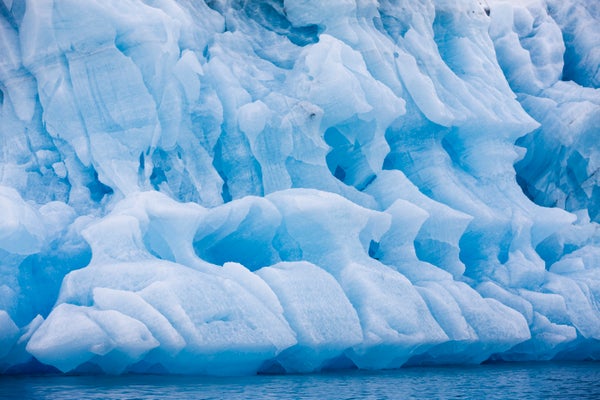
The waters of the fjords of Svalbard—the Arctic archipelago between mainland Norway and the North Pole—are known to snap, crackle and pop with the sound of melting icebergs and glaciers. Now new research finds the fizz of a thawing glacier can be distinguished from the burble of a softening iceberg, and that these telltale sounds are more intense in places where ice is melting faster.
The findings, published this month in Geophysical Research Letters, suggest this commotion can be tapped for useful clues as to how quickly glaciers may recede as temperatures climb—and thus how fast global sea levels might rise. “Now we can say it’s not just great that you can listen to the noise; it’s that we can…transform it into a real tool in the future,” says study leader Oskar Glowacki, a postdoctoral researcher at Scripps Institution of Oceanography.
Although satellites can be used to track the gradual retreat of glaciers, they cannot closely examine the site of the main action: the underside of a glacier's terminus—where seawater meets ice and drives melt. And it is dangerous for scientists to work along the fronts of glaciers, where huge icebergs regularly slough off into the sea, Glowacki says. Instead, placing underwater microphones called hydrophones in such areas could safely provide accurate measurements of the crucial melt process.
On supporting science journalism
If you're enjoying this article, consider supporting our award-winning journalism by subscribing. By purchasing a subscription you are helping to ensure the future of impactful stories about the discoveries and ideas shaping our world today.
To test this idea, Glowacki and his colleagues at the Polish Academy of Sciences deployed hydrophones in Svalbard’s Hornsund Fjord, near the terminus points of the Hans, Paierl and Stor glaciers. In the recordings the difference between glaciers and icebergs is unmistakable. Glacier fronts are chock-full of compressed air bubbles that fizz as they hit the water, creating a gentle, continuous sound like rain on a placid lake. There are fewer bubbles in an iceberg because they are so much smaller than their parent glaciers, so the popping noise they make is more irregular. They sound more like a pot of water at a rolling boil, with distinguishable sounds of individual bubbles bursting.
It was a victory to be able to separate the glacier and iceberg sounds, Glowacki says, and to distinguish the noise from the rest of the clatter of Svalbard’s bays and fjords. The hydrophones, he notes, pick up everything from the sound of waves lapping the shore to rain falling and the calls of sea mammals. In an even more exciting development the researchers found they could pick out the difference between the sounds on the side of an iceberg facing the local surface current and those on the protected side. Melt should be more rapid at the current-facing side, where the ocean water circulates against the ice, and this was reflected in more intense noise in the recordings. The finding suggests the strength of the ice noise can tell scientists where ice is melting faster.
Acoustic signals will probably never compete with visual satellite data, says ice sheet researcher Mauri Pelto, a professor of environmental science at Nichols College and U.S. representative to the World Glacier Monitoring Service. But Pelto, who was not involved in the new study, says the finding offers “another tool in the toolbox to deploy when and where it’s going to deliver the most value.”
Arctic glacial bays—which are among the loudest marine environments on Earth because of climate change—driven melt—would seem to be one such worthwhile place, Glowacki notes. “Why not take advantage of this,” he adds, “and listen to the planet?”