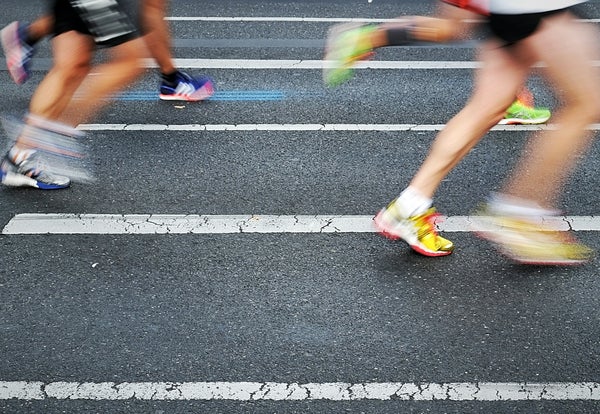
The fastest marathon ever run on record was by Dennis Kimetto of Kenya in the 2014 Berlin marathon for a time of two hours, two minutes and 57 seconds. That means he ran an average pace of four minutes 41.4 seconds per mile over the entire 26.2-mile course. Kenyan runner Eliud Kipchoge and Ethiopian runner Guye Adola came very close to breaking this record at the Berlin marathon earlier this year.
While the fastest marathon time for men has been slowly but steadily improving for the last 30 years or so, the women’s record has held firm since 2003. Paula Radcliffe of Great Britain set the time to beat at two hours 15 minutes and 25 seconds (an average pace of five minutes 9.9 seconds per mile) in London over a decade ago.
On supporting science journalism
If you're enjoying this article, consider supporting our award-winning journalism by subscribing. By purchasing a subscription you are helping to ensure the future of impactful stories about the discoveries and ideas shaping our world today.
Is there an absolute minimum time to run a marathon or will runners just keep getting faster? Will humans ever break the two hour mark? What does it take to set a world record marathon time? How does someone run a faster marathon?
Great science journalism requires human expertise, time, effort and creativity. And it costs money. That’s why I and the journalists here at Scientific American hope you’ll join our community.
When you subscribe, you are supporting staff and freelance journalists who are passionate about telling science stories that are true, important and compelling. Our editors and reporters are often experts in their fields, which means they understand the nuances of big discoveries and can untangle the breakthroughs from the hype. With a subscription, you are also supporting rigorous fact-checking to ensure the words we publish are precise and accurate. And you’re supporting original illustrations, graphics and photos that bring you closer to an advanced laboratory, an ice sheet in Antarctica or a space mission in orbit. You’re helping us craft other types of high-quality journalism as well: Our newsletters are carefully written, edited and curated by staffers you have or will come to know and love. Our Science Quickly podcast is based on original reporting, collaboration with editors and scientists and exacting production.
Subscriptions keep this engine running so we can continue to deliver thoughtful, rigorous and independent science journalism to you. In an era of viral misinformation, this work is crucial. If you value what we do, I hope you’ll consider joining us as a subscriber
Thank you,
Jeanna Bryner, Editor in Chief, Scientific American