August 21, 2009
1 min read
 Add Us On GoogleAdd SciAm
How great balls of fire shape planetary systems
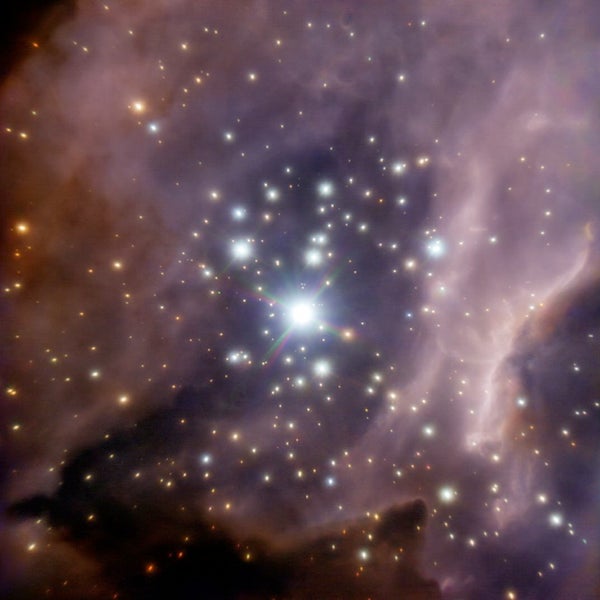
In the center of this image is IRS 2, an exceptionally bright, hot object in a massive cluster of stars known as RCW 38, some 5,500 light-years away in the southern constellation Vela.
On supporting science journalism
If you're enjoying this article, consider supporting our award-winning journalism by subscribing. By purchasing a subscription you are helping to ensure the future of impactful stories about the discoveries and ideas shaping our world today.
In the center of this image is IRS 2, an exceptionally bright, hot object in a massive cluster of stars known as RCW 38, some 5,500 light-years away in the southern constellation Vela. Researchers using the Very Large Telescope in Chile have now determined IRS 2 to be a binary system, a pair of stars separated by about 500 times the distance between Earth and the sun. The research team presents its findings in the July issue of the Astronomical Journal.
The sizzling duo, about seven or eight times as hot as the sun, dominates its neighborhood. A nearby star features a comet-like tail that could be the outer reaches of a protoplanetary disk evaporating under the intense ultraviolet radiation from IRS 2. Studying extreme regions such as that surrounding IRS 2 can show how that evaporation affects disks of planetary material. "Such knowledge," the new study's authors write, "will help to constrain the conditions that are necessary for those disks to evolve into planets."
It’s Time to Stand Up for Science
If you enjoyed this article, I’d like to ask for your support. Scientific American has served as an advocate for science and industry for 180 years, and right now may be the most critical moment in that two-century history.
SciAm always educates and delights me, and inspires a sense of awe for our vast, beautiful universe. I hope it does that for you, too.
If you subscribe to Scientific American, you help ensure that our coverage is centered on meaningful research and discovery; that we have the resources to report on the decisions that threaten labs across the U.S.; and that we support both budding and working scientists at a time when the value of science itself too often goes unrecognized.
In return, you get essential news, captivating podcasts, brilliant infographics, can't-miss newsletters, must-watch videos, challenging games, and the science world's best writing and reporting. You can even gift someone a subscription.
There has never been a more important time for us to stand up and show why science matters. I hope you’ll support us in that mission.