
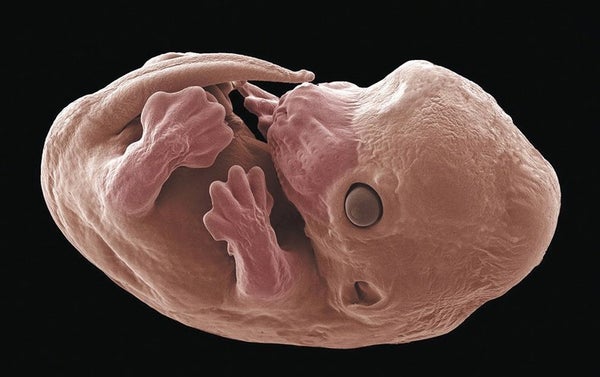
Species with symmetrical body plans have been roaming the earth for about 400 million years. Human beings have long shown an intense interest in this property in our own species—take the importance of symmetry in perceptions of beauty or the famous depiction of the outstretched human body in Leonardo da Vinci’s Vitruvian Man.
Now scientists have gone a step further. Alberto Roselló-Díez, a developmental biologist currently at the Australian Regenerative Medicine Institute at Monash University, led a study of how a mouse fetus maintains symmetry as it develops. By making one of the fetus’s limbs grow more slowly than the other, the team observed how cells communicate to ultimately correct the asymmetry. No study had successfully examined this phenomenon until now.
After a year of failed attempts, Roselló-Díez and his team created a model in mice. Borrowing a technique previously developed for modifying cells in a laboratory dish, the researchers injected into the mouse fetus’s left hind leg a type of cell that restricted the leg’s growth. They found that the cells surrounding the suppressed tissue communicated with the placenta, which then signaled the rest of the organism’s tissues—including the other hind leg—to slow their growth until the hindered limb caught up. Then, uniform growth resumed. The findings were published in June in PLOS Biology.
On supporting science journalism
If you're enjoying this article, consider supporting our award-winning journalism by subscribing. By purchasing a subscription you are helping to ensure the future of impactful stories about the discoveries and ideas shaping our world today.
Think of this process as a “three-legged race,” says Kim Cooper, a cell and developmental biologist at the University of California, San Diego, who was not involved in the study. “If one person is going faster, it’s harder to stay in sync. This placenta mechanism makes it possible for the slower one to catch up,” Cooper says.
The study offers insight into limb development and so-called catch-up growth. But the research also raises new questions: for example, once the limb has reached the same level of growth, how does the other limb know to start growing again? “We kind of expect symmetry in our limbs,” says Adrian Halme, a cell biologist at the University of Virginia, who was also not involved with the study. “But how they achieve that symmetry is really striking.”