How Medication Abortion with RU-486/Mifepristone Works

A step-by-step look at how these drugs end pregnancy

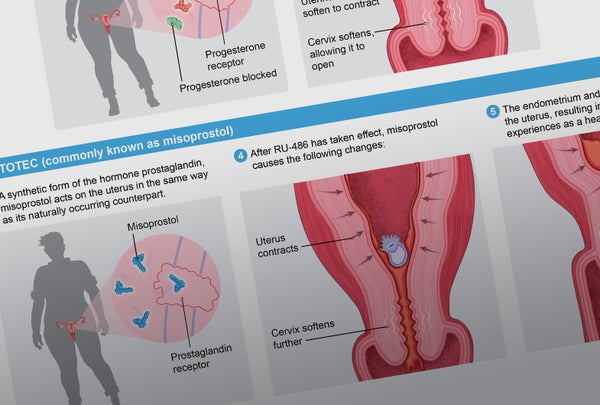
Detail of graphic shows how mifepristone and misoprostol act on the uterus and cervix to expel the embryo and endometrium.

Mesa Schumacher

Join Our Community of Science Lovers!

Editor’s Note (4/10/23): On Friday a federal judge in Texas ordered a hold on federal approval of the abortion drug mifepristone, which has been approved by the Food and Drug Administration for more than 20 years. The ruling is set to take effect within seven days of that order. On the same day a federal judge in Washington State ruled that no changes can be made to the drug’s availability in 17 states where abortion is legal or in Washington, D.C. This article, originally published in May 2022, describes how mifepristone works in concert with another drug, misoprostol, to end a pregnancy. 

In 2016 the U.S. Food and Drug Administration approved a two-drug combination of Mifeprex (also called RU-486 or mifepristone) and Cytotec (commonly known as misoprostol) to induce abortion without surgery. In 2019 the Centers for Disease Control and Prevention reported that approximately 42 percent of all abortions in the U.S. were medication-based.

To start the process, a person takes mifepristone within 10 weeks from their last period. One or two days later they take misoprostol. Both drugs work individually, but they are more effective together. Mifepristone blocks progesterone's action on the uterus, making it incapable of supporting a pregnancy. Misoprostol, among other things, starts uterine contractions.


On supporting science journalism

If you're enjoying this article, consider supporting our award-winning journalism by subscribing. By purchasing a subscription you are helping to ensure the future of impactful stories about the discoveries and ideas shaping our world today.


Credit: Mesa Schumacher

Research has shown medication abortion to be safe and effective. According to a 2015 study from the University of California, Los Angeles, 99.6 percent of more than 30,000 women who were seeking a medication abortion were able to terminate their pregnancies. In a review of clinical trials published in 2013, using mifepristone and misoprostol together, just 0.3 percent of the more than 45,000 women studied had complications that required hospitalization. The treatment did occasionally fail if the pregnancy was longer than eight weeks or if the instructions weren't followed. The mortality rate of the medications is less than 0.001 percent.

Megha Satyanarayana is chief special projects editor at Scientific American. She is a former scientist who has worked at several news outlets, including the Detroit Free Press and STAT. She was a Knight-Wallace Fellow, a cohort member of Poynter’s Leadership Academy for Women in Digital Media and a Maynard 200 Fellow.

More by Megha Satyanarayana

Mesa Schumacher is a medical illustrator and science artist with a passion for clear communication and engaging visuals. She is the principal artist of Mesa Studios. Her work can be found in magazines, books, journals, museums, zoos, aquariums and educational games.

More by Mesa Schumacher
Scientific American Magazine Vol 327 Issue 3This article was published with the title “How Medication Abortion Works” in Scientific American Magazine Vol. 327 No. 3 (), p. 80
doi:10.1038/scientificamerican0922-80

It’s Time to Stand Up for Science

If you enjoyed this article, I’d like to ask for your support. Scientific American has served as an advocate for science and industry for 180 years, and right now may be the most critical moment in that two-century history.

I’ve been a Scientific American subscriber since I was 12 years old, and it helped shape the way I look at the world. SciAm always educates and delights me, and inspires a sense of awe for our vast, beautiful universe. I hope it does that for you, too.

If you subscribe to Scientific American, you help ensure that our coverage is centered on meaningful research and discovery; that we have the resources to report on the decisions that threaten labs across the U.S.; and that we support both budding and working scientists at a time when the value of science itself too often goes unrecognized.

In return, you get essential news, captivating podcasts, brilliant infographics, can't-miss newsletters, must-watch videos, challenging games, and the science world's best writing and reporting. You can even gift someone a subscription.

There has never been a more important time for us to stand up and show why science matters. I hope you’ll support us in that mission.

Thank you,

David M. Ewalt, Editor in Chief, Scientific American

Subscribe