
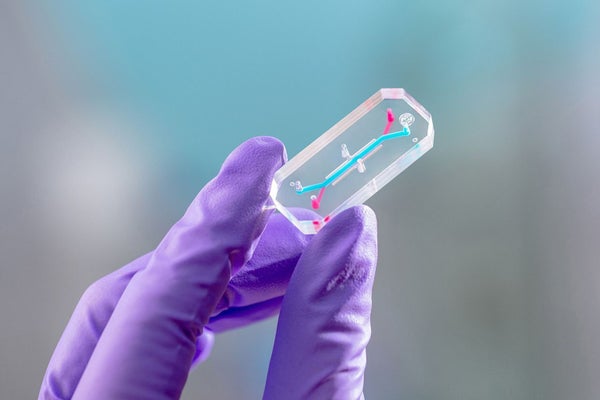
NASA’s Artemis II mission is on the way to the moon on a flight that will ultimately help inform long-term space exploration, including on the lunar surface itself. But before we can safely perform such missions, scientists need to better understand how radiation and microgravity affect our body. That’s why Artemis II is carrying a first-of-its-kind experiment: AVATAR, or A Virtual Astronaut Tissue Analog Response.
AVATAR uses organs-on-a-chip, fluid-filled devices, about the size of a flash drive, that are lined with living human cells. They are designed to mimic different human organs—and because an individual’s cells can be cultivated on a chip, they can even mimic a specific person’s organs. Scientists have been studying these models on Earth since 2010 and have learned valuable information about our biology, such as how the body might respond to new medications or stressors.
These organ-on-a-chip systems have been successfully tested and studied in low-Earth orbit onboard the International Space Station, but Artemis II is traveling far beyond that. As a result, AVATAR could unlock new insights into how the radiation and microgravity environment around the moon affect the body. Ultimately the experiment could help NASA one day create personalized medical kits for astronauts.
On supporting science journalism
If you're enjoying this article, consider supporting our award-winning journalism by subscribing. By purchasing a subscription you are helping to ensure the future of impactful stories about the discoveries and ideas shaping our world today.
“That’s going to be a huge step forward for us,” says Anthony Colaprete, acting director of the Science Directorate at NASA’s Ames Research Center, “especially as we send more and more crew into space.”
Organs-on-a-chip enable scientists to use real human cells to research and test medications and vaccines to model disease progression and map out microbial interactions in ways that would be impossible or difficult with animal testing (although animal models are still crucial for some medical research).
The AVATAR chips onboard Integrity, Artemis II’s spacecraft, contain bone marrow cells from the Artemis II astronauts and match a set of chips left on Earth. When the space-based chips are back on Earth, researchers will use single-cell RNA sequencing to measure gene-level changes within the cells, tracing the effects of longer-distance spaceflight in more detail than ever before.
Donald Ingber’s lab at the Wyss Institute for Biologically Inspired Engineering at Harvard University created the first organs-on-a-chip more than a decade ago. And he is now working with NASA on the AVATAR program, which is led by Lisa Carnell, director of the agency’s Biological and Physical Sciences Division.
“As someone who grew up watching all the NASA flights starting in the early 1960s and, in many ways, being inspired to enter science because of the excitement in America surrounding exploration in those days, it felt great to see the technology go up to space,” he says.
“We have the potential to fly large numbers of organ chips in future studies and to instrument the chips so that we get real-time imaging and functional readouts during the actual flight in the future,” Ingber says.
Because of the chips’ small size, future moon missions might be able to conduct many more science experiments in the same amount of space, and future medical kits might be more streamlined than the ones astronauts use today.
“Mass is always a critical commodity,” Colaprete says. “We can’t bring all the medicine there is. We don’t have the carry capability, so having this ability to know exactly what you need to bring is hugely important.”
Editor’s Note (4/9/26): This article was edited after posting to correct the description of Lisa Carnell leading the AVATAR program.