
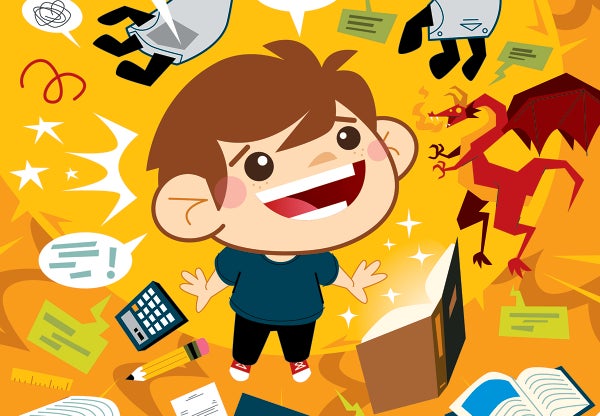
A dyslexia diagnosis was supposed to offer solutions for a boy named Tobey. It was first identified in a routine school screening, which led to tutors, speech therapy, a neuropsychological evaluation and a spot at a Manhattan school that could better suit his needs. But Tobey continued to struggle. One winter afternoon in early 2025, at age 11, he came home discouraged, says his mother, Arlyn Gajilan. Why, he asked, did she keep telling him he was smart? “‘I’m slower than everybody else. Why is it so hard for me?’” she recalls him asking. “That was like a gut punch,” Gajilan says.
Gajilan, who has worked at Reuters for more than 14 years and was then digital news director, had been reading about artificial intelligence and custom generative pretrained transformers, or GPTs—tailored AI models that users can configure for specific tasks. After determining her data would be private, she fed one of the models Tobey’s report cards, neuropsychological evaluations and individualized education programs for his dyslexia. She also gave it his interests: dragons from the book series Wings of Fire, battles with Nerf guns, a song or two from Hamilton. She told the GPT he was bright and competitive but found reading and writing difficult, and she asked it to look for the best pedagogical approaches. “You are a special education teacher with expertise in teaching kids with dyslexia,” Gajilan recalls writing. “Your job is to help my son.” Then she handed Tobey her smartphone.
The decision wasn’t made lightly. Although Gajilan worked in technology, she didn’t let Tobey use social media, and he didn’t have his own smartphone. “I’m very conscious of the harm that technology can do,” she says.
On supporting science journalism
If you're enjoying this article, consider supporting our award-winning journalism by subscribing. By purchasing a subscription you are helping to ensure the future of impactful stories about the discoveries and ideas shaping our world today.
But the GPT provided a creative approach that surprised her. It helped Tobey organize paragraph structure, topic sentences and syntax in exercises that it turned into games related to his interests. “My kid is a little sassy,” Gajilan says, “and the AI was giving back as much sass as he was giving. It would respond with things like ‘Game on’ or ‘Is that the best you’ve got?’” After every session, she would tweak the GPT, telling it to increase the difficulty or asking it to explain how a recent lesson was pedagogically sound. Her experience is just one example of the growing use of AI in educational tech—especially to create bespoke learning tools designed for the needs of individual students.
Vibe Coding a Solution
When Tobey first began using the GPT, he was skeptical. “I was like, ‘Could this really help me?’” he says. “But I was wrong. I can speak way more fluently and read more fluently, and I’m more confident with my math skills. I’m not doubting myself like I did before.” Gajilan checked in with Tobey’s teacher, Jacinta Capelli, who had noticed improvement over the course of several months. “Tobey demonstrated a notable increase in confidence,” Capelli recalls, although she couldn’t be sure AI was the cause.
Encouraged, Gajilan began considering how she could make the GPT available to her son’s friends. She’d been a journalist her entire adult life, covering tech and start-ups, and she had helped redesign the Reuters website and rebuild its app. “It wasn’t like I was coming at this purely from a Luddite space,” she says. “I knew what product requirements were, but I don’t know how to code.”
“This change to using AI is as profound, if not more profound, as when the Internet took over.” —Arlyn Gajilan
“Vibe coding”—using AI language models to write code—was increasingly in the news when Gajilan was thinking about how to develop an educational platform, and research suggests that it has quickly moved from novelty to norm. A 2025 study from software company JetBrains reported that 85 percent of developers regularly use AI tools, and 62 percent rely on at least one coding assistant, AI agent or code editor. Instead of coding manually, vibe coders write what they want the AI to build in the same way that they might send a Slack message to an employee. The AI translates this text into code, providing iterations until users have the results they want.
Gajilan began experimenting with different software. She’d made the custom teaching GPT in February, and during spring break, sitting at the kitchen table, she trained herself in the use of vibe-coding tools. She aimed to build her own platform based on principles drawn from 450 publicly available papers on learning differences, from dyslexia to attention deficit hyperactivity disorder. She designed a user dashboard and a questionnaire that asked new students about their motivations and struggles. This setup allowed the AI to build a learning profile with goals and a lesson plan that it could adapt depending on how users responded. By mid-June she had launched the beta version, and by July she had a dozen subscribers paying $29 a month, logging 30-minute sessions a few times a week.
During this process, Gajilan filed two patents for an algorithm she developed to recognize when users are becoming frustrated. “It looks at a variety of things: when a kid’s accuracy drops off, when it takes longer for them to respond and when they’re using key phrases like ‘I don’t know’ or ‘This is too hard,’” she says. When the system detects a combination of those factors, it creates wellness breaks, guiding the user through movements such as jumping jacks or mindfulness exercises. Gajilan also gamified the platform, which she and her son named Tobey’s Tutor. Tobey’s drawings helped to inspire the designs of badges that kids can earn for completing different levels.
Parents can log into the dashboard and see what their child is working on, the lesson plan and its rationale. The lessons are original; nothing is off-the-shelf or reused. There are no worksheets, just exercises made to fit a particular brain. Gajilan added guardrails, too: if a child types words that hint at self-harm, the platform alerts a parent.
AI in Education
As AI systems become more sophisticated, a growing body of research is finding they can be effective for learning. A 2023 study that was not peer-reviewed showed an increase in scores on a state math test among seventh-grade students in North Carolina who had used an AI educational tool, with some of the benefit still visible a year later. A large 2025 review of classroom trials also found that using AI often boosted learning.
Scott Gaynor, head of the Stephen Gaynor School, the Manhattan private school that Tobey attends, has followed the development of both AI in general and Gajilan’s platform, and he believes such a program could also help students who lack motivation for learning. For instance, low scores on standardized tests in the U.S.—only 22 percent of 12th graders achieved proficiency levels in math in 2024—have been attributed to many factors, from pandemic-related learning loss to widespread math anxiety to a general lack of interest.

Martin Gee
“This is where AI—and a program like Tobey’s Tutor—comes in: it can create high-interest, tailored questions for that student,” Gaynor says. “For example, [the hypothetical child I had in mind when I tried out the platform] was interested in tennis. I got a series of math word problems around tennis. There’s no way a teacher in a public school with 30 students could come up with 30 different worksheets with 10 word problems on them for each child’s interest. But once a program like Tobey’s Tutor gets to know the children, it will create word problems around anything you want. Right away you’ve engaged the student.”
Tobey says he likes how the AI makes exercises he hasn’t seen before. “When you strip all the Wings of Fire stuff away, you just have a boring math problem or a reading essay. But then it incorporates [my interests] in a way where you know you’re still learning something, but it makes it more fun.”
Tobey’s Tutor arrives as many schools are harnessing AI for learning. Public schools in Newark, N.J., have begun using AI-powered Amira Learning to help children learn to read. Educational company NWEA’s MAP Reading Fluency platform, a reading-assessment tool for children in pre-K through fifth grade, is used by 2,000 school districts nationwide and more than 1.4 million students; it recently added an AI “coach,” which, according to the company, provides “personalized reading coaching based on each student’s assessment results.” Google has launched the AI learning aid Read Along in Classroom, and Microsoft has both Reading Coach and Math Progress, which use AI to generate problems and check work. Stanford University’s Rapid Online Assessment of Reading platform uses AI to assess reading skills and dyslexia. Software company Dystech uses an AI-powered screener to evaluate whether students have learning challenges, and its Dystutor tool uses those results to create personalized practice suggestions.
AI tools for addressing individual differences in learning are arriving at a time when U.S. schools are often unable to fill teaching vacancies. As high schools approached the 2024–2025 school year, 69 percent of them struggled to find fully certified teachers for English as a second language or bilingual education, and 74 percent of elementary and middle schools reported difficulties filling special education teaching vacancies with fully certified teachers, according to the National Center for Education Statistics.
“I see the real potential of a program like Tobey’s Tutor in all these areas where [schools] don’t have expert instruction for children with learning differences,” Gaynor says. “There are a lot of educators who are fearful of AI creeping into the school and our students’ work. I see it as a great opportunity for children with learning differences to level the playing field.”
Just Keep Plugging Away
For Gajilan, seeing Tobey’s enthusiasm and growing confidence affirmed her decision to create the product. “The most heart-wrenching thing was not that my kid couldn’t do a math problem or couldn’t read an entire chapter without crying—that was upsetting, don’t get me wrong,” she says. “But the truly upsetting part was him thinking he wasn’t good enough to do those things.”
Gajilan’s own arc bent as she was improving the system. After years as digital news director, she stepped into a new role as global editor for AI development and integration, guiding the Reuters newsroom to use AI to support human work. “Doing this passion project opened my eyes to how profoundly AI is going to change the industry I’ve devoted my adult life to,” she says. “This change is as profound, if not more profound, as when the Internet took over.”
And lessons from the platform have returned to Gajilan in other ways. As she was driving Tobey home after a day at work—having spent most of the previous night fixing a bug in the program—a driver cut her off, and she cursed. From the back seat, Tobey asked what was wrong. As she tried to calmly tell him and apologized for swearing, he said he had learned it was important to just keep plugging away. When Gajilan asked where he’d learned that, he said, “Tobey’s Tutor.” “He was using these phrases I’d never heard him use before,” she says. “He was like, ‘Look, you just have to keep working the problem. It’s not going to be solved right away, but if you keep working at it, you’ll get there.’”