
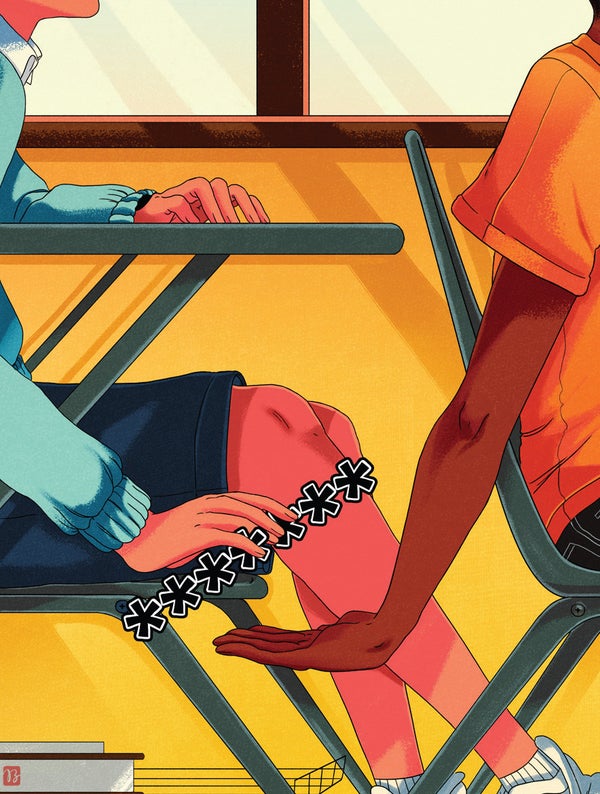
Decades ago a “subscription” generally referred to magazines or newspapers. Once you'd paid, the publisher didn't care how many times you read each article. You were even welcome to share an issue with family and friends. After all, a physical magazine has a built-in piracy limit: the number of people who can crowd around the pages simultaneously.
Digital subscriptions, though, are quite different. Companies care a lot about who uses them and how many are doing so at once. And no wonder: A digital subscription is really just a username and password. Without some software restrictions by Netflix, you could, in theory, share your password with everyone you know. And pretty soon Netflix would go out of business.
All right, so unlimited password sharing is unworkable. The question, though, is, What's the right approach to preventing it?
On supporting science journalism
If you're enjoying this article, consider supporting our award-winning journalism by subscribing. By purchasing a subscription you are helping to ensure the future of impactful stories about the discoveries and ideas shaping our world today.
The world is still trying to figure that out.
Netflix introduced streaming movies in 2007. No more waiting for a DVD in the mail! Instead—get this—you paid for your movie watching by the hour. You could pay $6 a month to watch six hours of movies, $18 to watch 18 hours, and so on.
Until that moment, humanity had always paid for movies by the movie—in the theater, on DVD or on pay-per-view. Netflix introduced a concept we now take for granted: movie surfing. Start a movie; if it doesn't grab you, start a different one. No big whoop.
Eventually Netflix adopted a flat fee for unlimited streaming movies, and the world was changed forever.
I fly a lot, so I pay $60 a month for unlimited Gogo, an in-flight Wi-Fi service. On a recent flight, though, I couldn't sign on. A message told me that there was some account problem. (It wasn't a total loss: I got to reacquaint myself with the wonderful world of in-flight magazines and safety cards.)
My daughter had used my account on a flight she had taken a week earlier (with my okay), and it turns out that's a Gogo no-no. “Customers are not allowed to share their Gogo account with anyone,” a rep told me—even if they're not using it simultaneously.
Wow. What powers Gogo, anyway—unicorn tears?
The New York Times's policy is similarly stern. “You are not allowed to share your registration login credentials,” its terms of service say. Violate that rule, and “we may refer you to appropriate law enforcement agencies.”
Contrast those approaches with services such as Netflix, Hulu and Spotify: Your monthly fee allows a specified number of simultaneous streams, such as two or four. The companies don't have to sweat over how many people have your password. All they care is that only two of you are watching or listening simultaneously.
The genius of that system is that it leaves enforcement up to us. We yell at our kids to get off Netflix when we, the parents, are trying to watch something. The customers do the antipiracy work.
Maybe such services can afford those friendlier guidelines because they have technical ways to enforce them. If you're paying for two simultaneous Netflix watchers, a third one can't tune in. Sites such as that of the Times, on the other hand, must rely on the honor system. (Well, the honor system and the threaten system.)
The password-sharing conversation must have been very brief at MoviePass, which is like Netflix for the cineplex. For $10 a month, you can see all the movies you want in theaters. What's to stop you from lending out your “login”? A plastic MoviePass card.
The world has gone subscription mad. Everyone says we're in a new golden age of TV series—but to see them, you'll have to subscribe to Netflix, Hulu, Amazon Prime, HBO Go, CBS All Access, and on and on. Add that to your Spotify or Apple Music subscription, your one for Photoshop or Microsoft Office, your antivirus subscription and the identity-theft plan that we may all need soon.
There's still no single standard for metering all this stuff. Here's to the ongoing experiments—and to the industry finding the right balance between convenience and profit.