
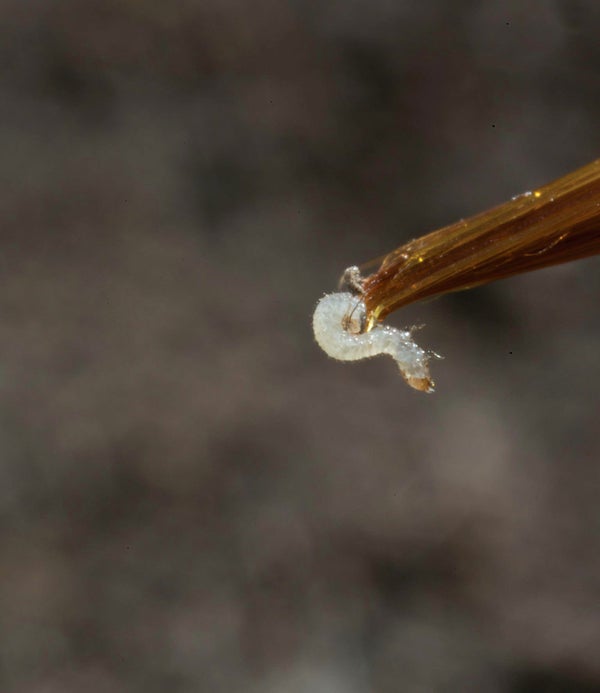
The western corn rootworm beetle grows to only the length of a grain of rice. But this unassuming yellowish-brown pest causes up to a billion dollars’ worth of damage to U.S. corn crops every year. Its larvae are particularly pesky; unseen, they wriggle through the soil to burrow into corn’s branching root system.
The larval worms find tasty roots by sensing underground gases and other chemicals, says Ricardo Machado, a chemical ecologist at the University of Neuchâtel in Switzerland. Researchers knew the worms were attracted to carbon dioxide, which corn roots release as a by-product of respiration. But Machado hoped to help researchers develop better pest-management strategies by delving into how, specifically, grubs use CO2 and other signals to home in on roots.
He and his colleagues used a technique called RNA inference (RNAi) to get to the root of things. They coated corn seedlings in a solution containing particular double-stranded RNA for larvae to eat, which halted expression of the gene that encodes rootworms’ CO2 receptors and made them unable to smell the gas.
On supporting science journalism
If you're enjoying this article, consider supporting our award-winning journalism by subscribing. By purchasing a subscription you are helping to ensure the future of impactful stories about the discoveries and ideas shaping our world today.
When tested, the newly CO2-insensitive worms could no longer locate corn plants’ roots from more than nine centimeters away, the team reports in eLife. But closer in, the worms could still sniff them out regardless of CO2 perception. Machado says this capability suggests the worms must use additional scents to narrow down their search—a “spectacular” display of the humble larvae using multiple inputs to reach their target.
Elisabeth Eilers, a chemical ecologist at Bielefeld University in Germany, says that while CO2 sensing was previously observed in rootworms, identifying and turning off the gene responsible is particularly revealing. “They went way deeper into this system than we had ever known before,” says Eilers, who was not involved with the study. She notes that many experiments test a bug’s sensing preferences and abilities by manipulating its body, such as by removing bits of antennae. The new method, she says, “is more straightforward and elegant than cutting an actual piece off of an insect.”
CO2 may play an important role in attracting the rootworm, “but roots are emitting a lot of different compounds,” Eilers says. She wonders how the worm might use those other chemical calling cards—a question Machado plans to investigate next by silencing more genes.
From the worm’s point of view, its underground sensing ability is a lifeline: it saves the tiny bug precious time looking for its next meal. “If an insect spends two days looking for its food,” Machado says, “for us that is like 20 years.”