
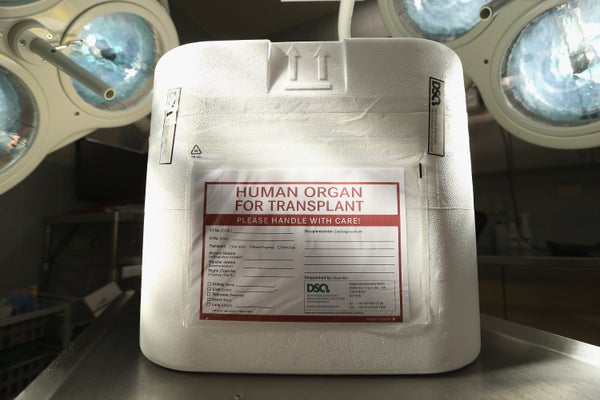
Using a special machine that pumps blood and other fluids around the body, researchers restored cells and organs in pigs an hour after the animals’ death by cardiac arrest. The feat holds the potential to one day increase the number of human organs available for transplants.
The team hooked up the animals’ circulatory system to OrganEx, a system that pumps a mixture of blood and a “perfusate” of fluid-borne nutrients around the body. Cells in all of the major organs of the pigs—which were anesthetized and euthanized—not only survived but also exhibited signs of cellular repair, the team wrote last week in Nature.
The system was adapted from an earlier model called BrainEx. In 2019 the researchers demonstrated the latter could be used to restore circulation in pigs’ brains after the animals’ death. The newest version, OrganEx, perfused the organs more effectively than a heart-lung bypass device known as an ECMO (extracorporeal membrane oxygenation) machine, which was tested on other pigs, the team wrote. In the new study, the experimental pigs were compared with three control groups of animals that were measured at various time points after death.
On supporting science journalism
If you're enjoying this article, consider supporting our award-winning journalism by subscribing. By purchasing a subscription you are helping to ensure the future of impactful stories about the discoveries and ideas shaping our world today.
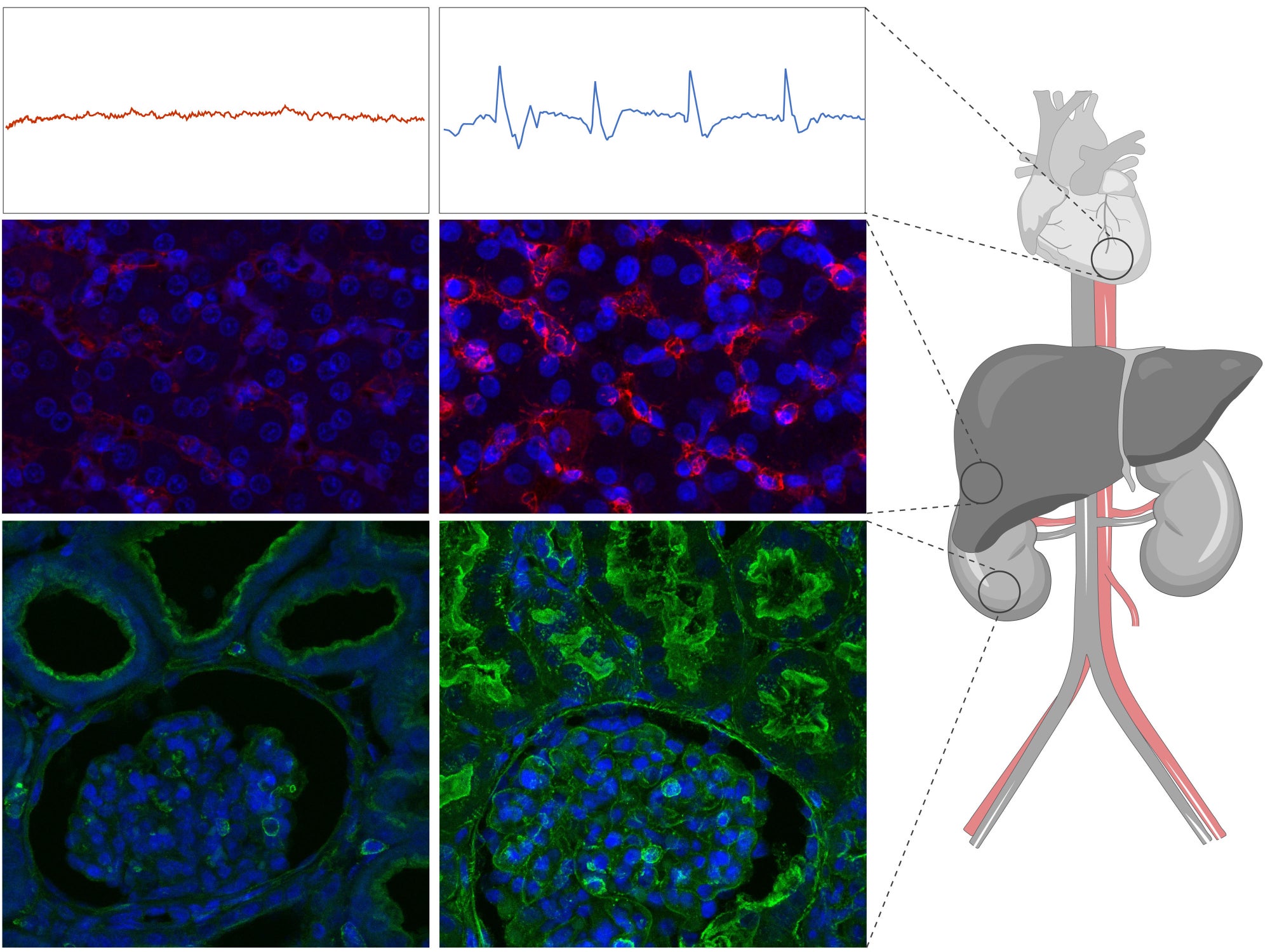
OrganEx technology reverses certain deleterious effects of prolonged ischemia. Representative images of electrocardiogram tracings in the heart (top), immunostainings for albumin in the liver (middle), and actin in the kidney (bottom). The images on the left side represent the organs subjected to a control perfusion, while the images on the right represents the organs subjected to perfusion with the OrganEx technology. Tissue integrity and certain cellular functions have been restored by the OrganEx technology one hour after circulatory arrest. Credit: David Andrijevic, Zvonimir Vrselja, Taras Lysyy, Shupei Zhang; Sestan Laboratory; Yale School of Medicine
After the system was in operation, none of the animals subsequently showed coordinated brain activity indicative of consciousness. Still, the experiments raise ethical questions about the definition and meaning of death.
Scientific American spoke with study co-authors Zvonimir Vrselja and David Andrijevic, both physicians and neuroscientists at the Yale School of Medicine, about how OrganEx works, the challenges in developing it and the ethical considerations.
[An edited transcript of the interview follows.]
Why did you develop the OrganEx system, and how does it build on your earlier BrainEx system?
VRSELJA: When our first study came out in 2019, the main takeaway was that things don’t die as quickly as we assumed they do. We had a lot of interactions with our colleagues after that. The idea was: if this works in the brain, which is the most complex and susceptible organ to [circulatory death], then it should work in all other organs as well. So we chose to try it in the whole body, one hour postischemia [after blood flow stops], and we can basically replicate the cell-saving findings of the original study. It’s still in its inception, but there is at least an idea now that these organs could be saved and used for transplants.
So is the idea that one could someday keep alive the organs of a person who has recently died, preserving them for longer periods of time before transplantation?
VRSELJA: Just think about the shortage of organs. There’s a big wait list. Kidneys, for example, are the most needed organ. And so now—if this system is optimized and advanced to a point where you can take people who have been dead for an hour and whose organs were not eligible for transplant—ideally, we [can] maybe start to tap into those organs. At the end of the day, it’s not science because of science. You want to do stuff because it matters.
ANDRIJEVIC: You want to help save people’s lives.
Can you explain how OrganEx works?
ANDRIJEVIC: Basically, the whole technology consists of two important components: One is a perfusion device that is similar to clinical heart-lung machines and closely resembles ECMO machines. We like to call it an “ECMO on steroids” because there are lots of different pumps and sensors, there’s an artificial kidney inside the system, and so on.
The other important part of the technology is the perfusate [the liquid that is pumped throughout the body], which is based on the first BrainEx perfusate. But now it is compatible with the whole body, and it’s been optimized to work on other vital organs, as we have shown in our paper, such as the kidneys, heart and liver. And also, in this whole-body setting, you have an activated immune system, coagulation system and autonomic nervous system. So this perfusate was optimized to control those things as well. We connect the animal’s vasculature to our system, and we control the perfusion of organs with our machine. Inside, the fluid that is circulating is actually a one-to-one mixture of the animal’s endogenous blood and our perfusate.
Why didn’t you use the animal’s blood alone rather than combining it with perfusate?
VRSELJA: It doesn’t work.
ANDRIJEVIC: Exactly. One of our control groups was just the clinical standard, ECMO, in which we just tried to restore the circulation using the animal’s own blood. And that was terrible.
Blood is a living tissue. When you wait for an hour, that living tissue—those cells that are inside—start to die. You just can’t restore the circulation with those dead things that are inside the blood. Our perfusate is completely acellular—it doesn’t have any cells.
Your system pumps the blood-perfusate mixture around. At that point, is the animal’s heart not pumping itself?
ANDRIJEVIC: We have observed, as reported in the paper, restoration of electrical ventricular activity of the heart. Also, with our eyes, we have observed that the heart indeed is contracting. But the quality of those heartbeats is debatable, and we have not assessed it in a proper way.
How did your system keep the pigs’ cells from dying after the animals were euthanized by means of an electric shock?
VRSELJA: When cells undergo a shock [such as when blood stops pumping], they initially try to die.
ANDRIJEVIC: Then, once you restore the circulation, you can actually reach out to those organs with our perfusate, a specifically tailored drug cocktail that affects the cells and tells them, “Don’t die; there is hope.”
Do you see your system being used for humans with life-threatening organ failure in the future?
VRSELJA: That’s a hard question to answer, because right now we’re geared toward organ recovery.
ANDRIJEVIC: It’s going to take lots of animal studies to confirm that this works and to what extent, and so on, before we even think about translating this technology.
How did you address some of the ethical considerations with the OrganEx experiments?
ANDRIJEVIC: We were really careful. All of our experiments have been planned and overseen by both Yale’s [Institutional Animal Care and Use] Committee and external advisory [and ethics] committees. Throughout the whole experiment, we cooled down the animals to decrease their brain activity, and we put neuronal blockers into our perfusate to decrease [brain activity]. Also, we added anesthesia throughout the experiment.
Do you foresee a point at which you would say that these experiments have gone too far?
VRSELJA: We are working on cell recovery, and we have always had a ground-up approach. And for these things to happen, cells need to be alive. But with all the work that was done in recent years, in terms of bioethics and developing guidelines and approaches, there’s clearly societal involvement and interest in this. I think it’s up to a broader community of scientists and ethicists to guide this to a point where it becomes reasonable to do something.
You just want to make sure that, in the end, you address the underlying issue, which is the organ shortage, and you want to do it in the best way.