
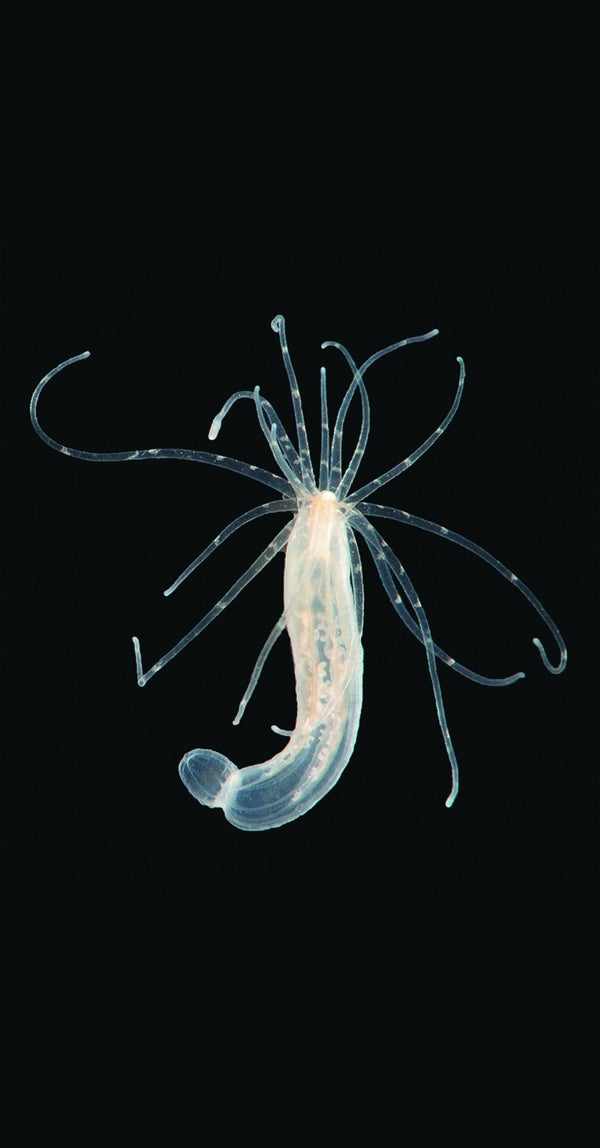
Jellyfish, sea anemones and corals, a group called cnidarians, sting with tiny, pressurized capsules that fire poisonous darts at explosive speeds. Researchers have been unsure of the exact mechanics of this blisteringly fast process, which occurs using special cell organelles called nematocysts. Now a team led by Matt Gibson and Ahmet Karabulut of the Stowers Institute for Medical Research in Kansas City, Mo., has used cutting-edge imaging technology to study nematocyst firing in very fine detail. Understanding the biophysics of what they call “one of nature's most exquisite biological micromachines” could inspire the design of minuscule drug-delivery devices, the researchers say.
This discovery, reported in Nature Communications, was aided by serendipity: Karabulut found that a chemical used to prepare sea anemone stinging cells for imaging also induced the nematocysts to discharge—and it fixed them, or preserved their cellular structure, at various stages in the process. Using super-resolution fluorescence and electron microscopes, the researchers observed a detailed sequence of events involving a stiff shaft and a flexible, whiplike filament that starts out coiled around it within the nematocyst.
Cells don't have space to operate a slingshot-type mechanism to propel a stinger, “so they evolved another way,” Karabulut says. Both the shaft and the filament are inside out and neatly folded into the tiny organelle. When the nematocyst fires, the shaft is ejected first and turns right-side out. Then the filament unwinds and moves through the shaft, flipping right-side out as well. This flip turns the tiny, inward-facing barbs on the filament's surface outward to release toxins into unlucky prey.
On supporting science journalism
If you're enjoying this article, consider supporting our award-winning journalism by subscribing. By purchasing a subscription you are helping to ensure the future of impactful stories about the discoveries and ideas shaping our world today.
Seeing this two-phase discharge process is “such a huge contribution to understanding the mechanics of turning this organelle inside out,” says Cornell University evolutionary biologist Leslie Babonis, who was not involved in the study.
In the future, scientists could engineer “designer” cnidocytes to deliver drugs exactly where they are needed, Babonis says. “I don't think it's that far-fetched to think that this could be something that could be adapted or co-opted for use in medical systems or therapeutics.”