
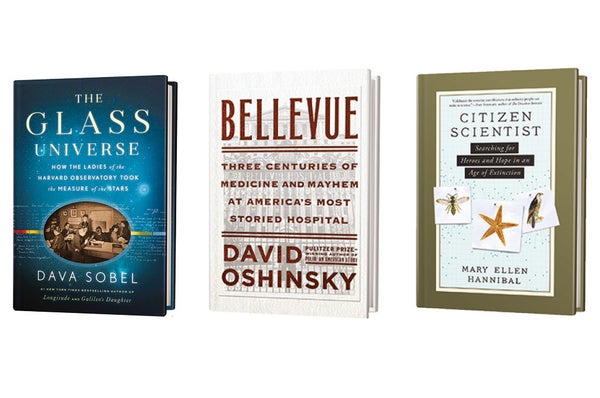
The Glass Universe: How the Ladies of the Harvard Observatory Took the Measure of the Stars
by Dava Sobel.
Viking, 2016 ($30)
Originally hired as human “calculators” to offer mathematical assistance to the scientists at the Harvard College Observatory starting in the late 1800s, a group of intrepid women soon began interpreting the data they were meant to crunch. They painstakingly analyzed the photographic plates of the heavens collected night after night at the observatory’s telescopes. They were able to use their analyses to classify stars based on the characteristics of their light, discover patterns among stars whose brightness varies periodically and identify double-star systems, among other achievements. Through letters, journal entries and historical documents, science writer Sobel sketches an inspiring portrait of these women who helped to pave the way for female astronomers at a time when women were not even allowed to vote, let alone participate in most academic fields. She brings to life characters such as Henrietta Swan Leavitt, Annie Jump Cannon and Antonia Maury, whose contributions were so noteworthy they gained some recognition from the wider field, as well as Edward Charles Pickering, the observatory director who recruited more than 80 women and championed their successes.
Bellevue: Three Centuries of Medicine and Mayhem at America’s Most Storied Hospital
by David Oshinsky.
Doubleday, 2016 ($30)
On supporting science journalism
If you're enjoying this article, consider supporting our award-winning journalism by subscribing. By purchasing a subscription you are helping to ensure the future of impactful stories about the discoveries and ideas shaping our world today.
“Under-budgeted, understaffed, and crammed with patients” have been constants throughout the nearly 300-year history of New York City’s Bellevue Hospital, the oldest continuously operating hospital in the U.S. Historian Oshinsky tells the story of this home to the city’s ailing immigrants and poor and its intersection with the histories of American health care and New York City. Bellevue has weathered many trials over the years, including public health crises from yellow fever, typhus, Spanish flu and AIDS—epidemics made worse at the hospital by classism, racism and xenophobia, which drove wealthier New Yorkers and their money away from struggling Bellevue. But the hospital’s story is also one of innovation and progress: it opened the U.S.’s first nursing school in 1873 and developed the nation’s first modern pathological laboratory course in 1878. —Ryan F. Mandelbaum
Citizen Scientist: Searching for Heroes and Hope in an Age of Extinction
by Mary Ellen Hannibal.
The Experiment, 2016 ($25.95)
“Citizen science is taking off as never before, and it is needed as never before,” writes journalist Hannibal in this celebration of nonexperts’ contributions to science. By monitoring whales offshore, hawks in the sky, sea stars in tide pools and galaxies in the universe, scienceinterested volunteers are contributing to global studies that desperately need their additional manpower and brainpower. And technology these days, particularly in the form of smartphones, is allowing more people to collect more useful data than ever before. The result is that folks who used to be part of the landscape of subjects studied by science are becoming “cocreators” ofscience, which benefits them and the research they contribute to, Hannibal writes. An avid citizen scientist herself, she traces the roots ofamateur research and explores its effects both on the world at large and in her own life, especially in helping her deal with the recent unexpected death of her father.