
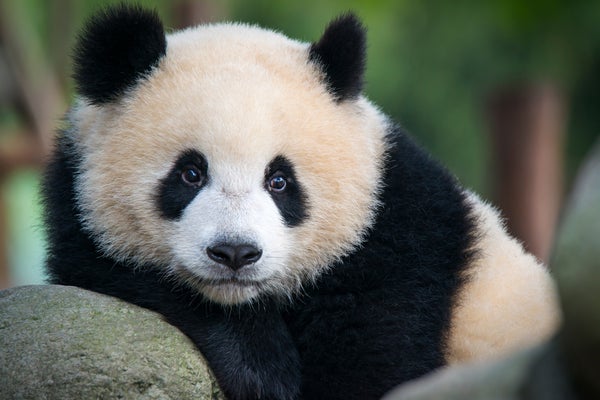
Giant pandas and the distantly related red pandas may have independently evolved an extra ‘digit’—a false thumb—through changes to the same genes.
The two species share a common ancestor that lived more than 40 million years ago. Giant pandas (Ailuropoda melanoleuca) are distant relatives of other bears, whereas red pandas (Ailurus fulgens) are more closely related to ferrets. Both species subsist on a diet composed almost entirely of bamboo, with the help of a false digit.
The pandas’ ‘thumbs’—which are actually abnormally enlarged wrist bones—allow both species to grip and handle bamboo with remarkable dexterity. But “exactly how such evolutionarily distant animals evolved such a similar lifestyle and body form has long been a mystery,” says Steve Phelps, a geneticist at the University of Texas at Austin.
On supporting science journalism
If you're enjoying this article, consider supporting our award-winning journalism by subscribing. By purchasing a subscription you are helping to ensure the future of impactful stories about the discoveries and ideas shaping our world today.
In a new study, Wei Fuwen and Hu Yibo, conservation geneticists at the Chinese Academy of Sciences’ Institute of Zoology in Beijing, and their colleagues, produced the first genome sequence of the red panda and compared it with the giant panda genome. This comparison turned up a list of 70 genes that showed signs of evolutionary change in both species.
Two of the genes, DYNC2H1 and PCNT, are important for limb development, and mutations in these genes can cause bone and muscle abnormalities, including extra digits, in mice and humans. Both pandas also share single amino-acid changes in the proteins encoded byDYNC2H1 and PCNT that are not found in 60 other mammal species. The researchers propose that these changes could have contributed to the pandas’ false thumbs.
Seven other genes on the list—including those involved in absorbing vitamins and amino acids that the body cannot produce—may have helped both pandas subsist on nutrient-poor bamboo, says Wei. The team’s findings were published on January 16 in Proceedings of the National Academy of Sciences USA.
Andrew Foote, an evolutionary biologist at Bangor University, UK, says that the team has come up with a “very strong” list of candidates to explain the pandas’ shared adaptations to a unique lifestyle. But he notes that the study was designed to identify only those genetic changes shared by both species—and not those unique to one panda or the other that also contribute to their similarities.
David Stern, a geneticist at the Janelia Research Campus of the Howard Hughes Medical Institute in Ashburn, Virginia, stresses that additional experiments—in transgenic mice, for instance—will be needed to prove that mutations in genes including DYNC2H1 and PCNTcontributed to adaptations such as the pandas’ thumbs. But he notes that the study fits in with a growing body of literature that suggests that organisms that face the same challenges often adapt in genetically similar ways. Evolution, Stern says, “is actually much more predictable than anybody predicted.”
This article is reproduced with permission and was first published on January 16, 2017.