
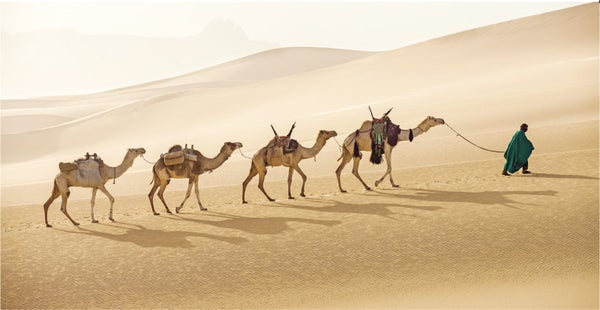
The Sahara is the world's largest and most legendary subtropical desert, but knowledge about it is surprisingly limited. Even estimates of when it formed vary widely, from more than five million years ago to mere thousands. Now, however, geologists studying wind-carried Saharan dust on the Canary Islands have come closer to pinning this down: it is, they report, close to five million years old.
One reason for the uncertainty over the Sahara's age is that researchers use such different methods to estimate it; these include studying desert dust found in sediment under the Atlantic Ocean, analyzing sandstone and modeling the ancient climate. To help settle things, geomorphologist Daniel Muhs of the U.S. Geological Survey (lead author on the new research) and his colleagues looked at sediment on Spain's Fuerteventura and Gran Canaria islands, where they found evidence of Saharan dust. The dust appeared in ancient soil layers, whose age they assessed on the basis of fossils found in the same layers—and that age agreed with earlier marine sediment studies. The researchers reported their finding in November in Palaeogeography, Palaeoclimatology, Palaeoecology.
“The conclusion of the study is very good,” says Zhongshi Zhang, a climate modeler at the University of Bergen in Norway, who was not involved in the work. Because the dust found on the islands is distinct from the marine record, Zhang adds, it helps to build the case for a multimillion-year age.
On supporting science journalism
If you're enjoying this article, consider supporting our award-winning journalism by subscribing. By purchasing a subscription you are helping to ensure the future of impactful stories about the discoveries and ideas shaping our world today.
The Sahara is the biggest source of airborne dust in the world—and that dust's journey does not end in the Canary Islands, which lie just off the western coast of Africa. It continues on to places such as the Caribbean and the Amazon rain forest, Muhs notes. Amazon soils are poor in nutrients, and he says the new results help to show how nourishing dust from Africa could have been supporting the South American region's incredible biodiversity for millions of years—adding to the Amazon's own origin story.