
In the Before Times, science and health journalists would talk about how much we appreciated our readers but just wished that more people took an interest. In the Pandemic Times, we have to add: but not like this! It's been a scary and exhausting year but also the most educational time in living memory. Hundreds of millions of people now understand concepts such as epidemiological modeling, asymptomatic transmission, herd immunity, phase 3 vaccine trials, and more. Our collective vocabulary has expanded with serious and grimly funny terms like “pandemic fine” (in response to “How are you?”) or “Blursday” (in response to “What day is it?”).
As the pandemic starts to come under control, we at Scientific American are grateful for all the scientists around the world who collaborated at lightning speed on studying the coronavirus and creating vaccines, the health-care workers who developed best practices to treat sick patients while their own lives were in danger, all the experts who talked with reporters to get the right information to the public, and especially to everyone—to all of you—who has helped spread knowledge.
Public policy scholar and communication professor Kathleen Hall Jamieson shares evidence-based, practical advice for how best to do just that. Anyone can be an effective science communicator and support a culture that endorses science by using her pro tips to help friends reject myths about the coronavirus, vaccines, masks, or (is this really the year 2021?) whether Earth is round or flat.
On supporting science journalism
If you're enjoying this article, consider supporting our award-winning journalism by subscribing. By purchasing a subscription you are helping to ensure the future of impactful stories about the discoveries and ideas shaping our world today.
We have a trio of stories this month about how astronomers and physicists are using new technology to understand some of the biggest mysteries in the universe. The far side of our moon could soon be teeming with radio telescopes, orbiters and rovers, as author Anil Ananthaswamy explains. Shielded from Earth's radiation, it's an ideal place to look for signs of the universe's dark ages, the first few hundred million years after the big bang.
Adaptive optics technology gives telescopes a crisper view of distant objects by compensating for turbulence in the atmosphere—it's a way to “untwinkle the stars.” Astronomers Tony Travouillon and Céline d'Orgeville and optical instrumentation expert Francis Bennet share how the technology is now being used to study space debris and could allow clear and secure quantum-encrypted communication.
If any experiment is likely to detect dark matter particles in the coming years, it's a new version of XENON at the Gran Sasso National Laboratory in Italy. See the magnificent instruments being set up now, as senior editor Clara Moskowitz describes them.
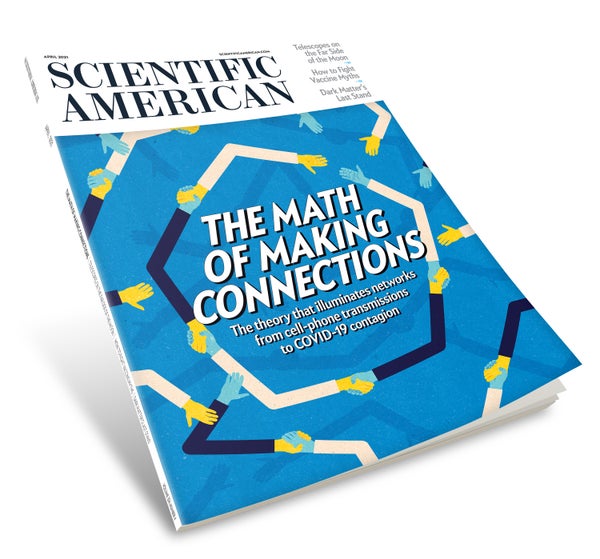
Mathematics based on simple connection diagrams underlies some of the most complex networks of modern life, including cell-phone networks, viral memes on social media, or even the spread of disease. In our cover story, mathematician Kelsey Houston-Edwards shows the power of “percolation theory.”
Natural gas is the biggest source of electricity in the U.S., and consumption has risen about 30 percent in the past 15 years. It's not going away, but a range of achievable technologies can make it much more climate-friendly, as energy resources expert Michael E. Webber explains.
Our flight of fancy for April takes wing. Paleontologist Michael B. Habib and illustrator Terryl Whitlatch blend biomechanical rules and research on pterosaurs and other extinct creatures to create plausible body plans for dragons, angels and flying horses. We had a lot of fun with this one and hope you do, too.