
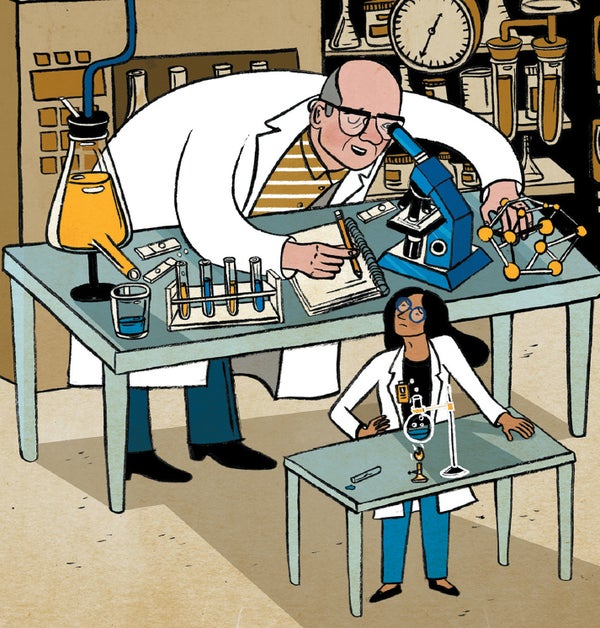
Are women scientists getting an even shake as they try to advance their careers? Research on the subject suggests maybe not. For example, a new study published in the journal Academic Medicine finds that a substantial salary gap favors male scientists to the tune of $20,000. Another study suggests evidence of bias against women's ability to keep a steady stream of research funding, which is the lifeblood of any scientist's career.
By some measures, female scientists are doing well. Women make up about half of all new Ph.D.s and M.D.s., and roughly equal numbers of women and men start as assistant professors. Moreover, research has shown that white women were as likely as white men to earn a research project grant from the National Institutes of Health, a crucial first step toward achieving career independence and tenure. That same study, however, showed that Asian and African-American women scientists were less likely to receive funding, pointing to a “double bind” for women of color. Such nuances matter in a hypercompetitive research-funding environment in which only one in three scientists (women or men) gets enough NIH grant money to keep a laboratory afloat.
And there are many more nuances. For example, after getting research money, women may face hurdles to keeping funds flowing long enough to make discoveries. After three to four years of a research grant, scientists must convince the NIH that they have gotten results to continue receiving money for more research. In a text-mining analysis of comments used by “peer” scientists to review grants, researchers discovered that those reviewers used more laudatory words such as “outstanding” and “excellent” to describe women's applications yet scored them lower than submissions by men. This evidence suggests that reviewers use different standards to judge applications from women.
On supporting science journalism
If you're enjoying this article, consider supporting our award-winning journalism by subscribing. By purchasing a subscription you are helping to ensure the future of impactful stories about the discoveries and ideas shaping our world today.
Women also receive less funding from universities right from the beginning of their careers: on average, they get 40 percent less money to start their labs. Time off from the job is often treated differently as well. Men often use “culturally acceptable” paid leave, such as sabbaticals, which have no impact on their pay. Although women also take sabbaticals, they are more likely than men to take family-related leave, which still incurs stigma. In many cases, women simply choose not to take leave. We need to revisit outmoded, family-unfriendly policies. We should also reexamine academic biases against part-time faculty and reframe work-life issues as career-advancing rather than career-pausing. We know that flexible work arrangements can improve satisfaction and even performance.
We can fix at least one issue—compensation—simply by holding university deans and presidents accountable. Salary equity should be a critical element of leadership performance reviews. In the case of grants, we know one group that is disadvantaged. A recent NIH analysis showed that applications from African-American scientists are funded at a significantly lower rate than applications from white scientists (11 versus 17 percent). The NIH is now studying whether removing all personal identifiers in a grant application makes a difference in how it is scored. If it does, then removing personal identifiers may also affect how women's applications are reviewed. Finally, we must address the recently highlighted problem of sexual harassment, which affects both genders but which is disproportionately suffered by women.
Women bring unique perspectives to research, and as a nation, we need all the best ideas we can get. It is in everyone's interest to correct this issue, and progress relies on women and men shifting culture. Transgressions are often unintended. But the stereotypes we carry unconsciously, and often unintentionally, lead to biases, which have powerful effects on satisfaction, productivity and career advancement. Our failure to eliminate the inequities facing women in science would represent a failure for women and men alike, as well as for the enterprise of biomedical research.