
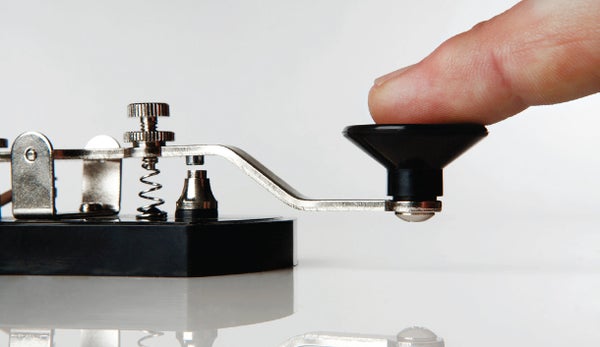
Learning Morse code, with its tappity-tap rhythms of dots and dashes, could take far less effort—and attention—than one might think. The trick is a wearable computer that engages the sensory powers of touch, according to a recent pilot study. The results suggest that mobile devices may be able to teach us manual skills, almost subconsciously, as we go about our everyday routines.
Ph.D. student Caitlyn Seim and computer science professor Thad Starner of the Georgia Institute of Technology tinker with haptics, the integration of vibrations or other tactile cues with computing gadgets. Last September at the 20th International Symposium on Wearable Computers in Heidelberg, Germany, they announced that they had programmed Google Glass to passively teach its wearers Morse code—with preliminary signs of success.
For the study, 12 participants wore the smart glasses while engrossed in an online game on a PC. During multiple hour-long sessions, half the players heard Google Glass's built-in speaker repeatedly spelling out words and felt taps behind the right ear (from a bone-conduction transducer built into the frames) for the dots and dashes corresponding to each letter. The other six participants heard only the audio, without the corresponding vibrations.
On supporting science journalism
If you're enjoying this article, consider supporting our award-winning journalism by subscribing. By purchasing a subscription you are helping to ensure the future of impactful stories about the discoveries and ideas shaping our world today.
After each run of game playing, all the players were asked to tap out letters in Morse code using a finger on the touch pad of the smart glasses; for example, if they tapped “dot-dot,” an “i” would pop up on the visual display. The brief testing essentially prompted them to try to learn the code. After four one-hour sessions, the group that had received tactile cues could tap a pangram (a sentence using the entire alphabet) with 94 percent accuracy. The audio-only group eventually achieved 47 percent accuracy, learning solely from their trial-and-error inputs.
The work shows that “it is possible to teach a system of typing without the user paying much attention to it,” Starner says. Passive haptic learning could help users quickly master new text-entry methods for accessory keyboards or an eyes-free, Morse code–like system of taps on a smart watch, he adds, noting: “That might really change how people use mobile and wearable devices.”
The results are also “exactly congruent” with other effects of passive haptic learning that the researchers have found in past studies, Seim says. For example, the group has developed computing gloves that deliver vibrations to the fingers to teach the “muscle memories” for playing a piano song or typing Braille.
Although it was small scale, the experiment demonstrates how wearable computers could permit users to “go about your daily business—and while you do that, you can get information to actually learn things,” says Paul Lukowicz of the German Research Center for Artificial Intelligence, who was not involved in the study. Now if only listening to Mandarin in your sleep could impart fluency.