
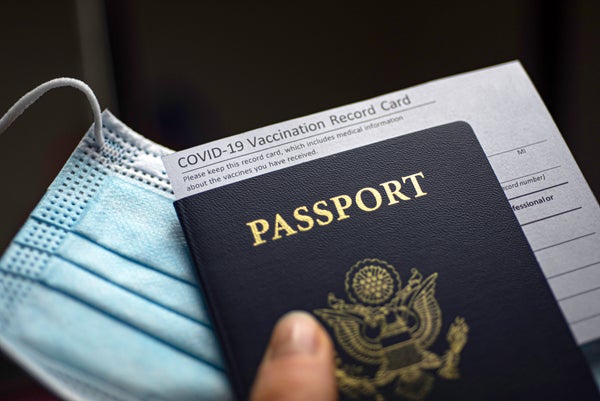
Proof of vaccination against COVID-19 may soon be a requirement for airline or cruise ship passengers looking to embark on future voyages. Some companies—like Qantas Airlines and the American Queen Steamboat Company—have come forward saying they will require such proof, so called “immunity passports,” to use their services. And some employers may soon mandate vaccinations as well. Tech companies, too, are working on developing technology required for digital immunity passports, predicting that they will be widely used in the near future. Already, to fly to the U.S. and many other countries, passengers must provide a negative COVID test. But are immunity passports really a good way out of the pandemic?
Immunity passports promise a way to go back to a more normal social and economic life, but the benefits they generate will be dispersed unequally, and it is not obvious that they are ethical. On the one hand, immunity passports offer an opportunity for employees to go back to work and families to reunite. On the other hand, they will not be available to everyone, and they will exacerbate existing inequalities.
Immunity passports may be inevitable, given current developments in the private sector and historic precedent, but in order for them to be ethical, they must at least include some exceptions. People who cannot access vaccines for health reasons but need to work, attend school, travel and so forth should be able to do so when the benefits exceed the risks. Moreover, the benefits of allowing immunity passports should be equitably distributed.
On supporting science journalism
If you're enjoying this article, consider supporting our award-winning journalism by subscribing. By purchasing a subscription you are helping to ensure the future of impactful stories about the discoveries and ideas shaping our world today.
There are many scientific uncertainties surrounding COVID-19 immunity and, like all vaccines, vaccines against COVID-19 do not offer perfect protection. Scientists do not know, for instance, how long vaccine-derived immunity lasts or whether people who have been vaccinated can still transmit the virus. Similarly, antibody tests are imperfect, and we know that people can be reinfected even once they have had the virus. Immunity passports should only be offered to people who pose very little risk to others.
Moreover, an ethical immunity passport system should not exacerbate inequality. Access to the vaccine is very unequal in different regions and even within the same region. Some people cannot be vaccinated because they have serious health conditions. Others cannot be vaccinated because they are allergic. Yet others will have to wait because they are not in priority groups and supplies are limited, or because they happen to live in a region that is less efficient at delivering vaccines. So, immunity passports should at least allow for exceptions for people who cannot or should not be vaccinated.
To be ethical, immunity passports must include welfare exceptions. Some people who cannot access vaccines live with abusive partners, some suffer severe mental illness resulting from social isolation, some desperately need to be able to work in places that require social interaction to support their families. Others need a passport to reunite with family. Not providing an opportunity for these people to engage in social activities because they cannot access a vaccine and, so, lack an immunity passport, while others can break free from abusive partners, engage in social interactions that improve their mental health, go back to work and reunite with family members is gravely unfair. Imagine being willing to quarantine and then take the risk of flying to visit a dying family member, but being denied access from the airlines because you cannot get vaccinated.
In short, immunity passports should only be offered to people who pose very little risk to others, and have ethical immunity passport systems, we must allow some exceptions.These must include health and welfare exemptions so that people who cannot access vaccines for health reasons but need to work, attend school, travel and so forth can do so when the expected benefits exceed expected costs. If prospective travelers, or their family members, have serious economic, health or other needs, they should be able to secure a limited passport to access essential services—whether that requires going to work, traveling or attending school as long as they agree to take appropriate precautions (e.g., get tested, wear a mask, and social distance insofar as possible).
At least they should be allowed to access the things they need when the risks that they pose to others are limited and the cost of denying them access is significant. A single immunocompromised mother who cannot get a vaccine given her health status may, for instance, need her children to be able to attend school and may need to work outside of her home to make ends meet, while posing limited risks to others. An ethical immunity passport system must allow this.
Insofar as possible, the benefits of allowing immunity passports should be distributed equitably. The net monetary gains from greater economic activity should, for instance, support broader recovery efforts and those who have lost their jobs because of the crisis. It is also important to support those who must wait to access the services, and good immunity passports should provide other kinds of social support in the interim. Anything less is inequitable.
This is an opinion and analysis article.