
Canada's tar sand projects sprawl across 600 square kilometers of northeastern Alberta. Prime Minister Stephen Harper has called the industrial effort to extract oil from the deposits “an enterprise of epic proportions, akin to the building of the pyramids or China's Great Wall. Only bigger.”
As traditional oil and natural gas reserves become increasingly difficult to find, and as demand rises, energy companies are turning to unconventional resources that, like the tar sands, are harder and more costly to access. Production of tar sands–based oil, for instance, has tripled over the past decade, reaching 1.6 million barrels a day in 2011.
Given that unconventional sources are needed, which ones make the most sense to extract? It takes an unusually high amount of energy to get at them—whether it be tar sands, natural gas from hydraulic fracturing shale, or old oil deposits that can be flooded with steam to scour out more petroleum. To help compare fuel sources with a common metric, ecologist Charles A. S. Hall of the S.U.N.Y. College of Environmental Science and Forestry has created a measure called the “energy return on investment” (EROI). It indicates the energy that fuels provide per unit of energy spent—a ratio of energy obtained. A higher EROI means more energy is available to put to work. On the opposite page and on the ones that follow, I examine the inputs and outputs of various fuel sources to explain their EROIs.
On supporting science journalism
If you're enjoying this article, consider supporting our award-winning journalism by subscribing. By purchasing a subscription you are helping to ensure the future of impactful stories about the discoveries and ideas shaping our world today.
“Everywhere you look, the EROI is declining,” Hall says of oil and gas. His modeling suggests that a modern economy requires liquid fuel with an EROI of at least five; as the EROI decreases, society spends so much money on energy production that the costs eat into funds that could be spent elsewhere, whether on education, health care or entertainment.
By that measure, few options in the transportation sector are appealing [see top illustration on next two pages]. Yet low-EROI fuels are increasingly needed to meet ever higher demand, according to the International Energy Agency (IEA). Already, the IEA warns, oil prices are in the “danger zone,” threatening economic growth. The electric power industry enjoys better EROIs [see bottom illustration on next two pages] because of access to more abundant resources.
The EROI measure does not evaluate all the benefits and drawbacks of a fuel; notably, it does not address the environmental cost of greenhouse gas emissions or supply problems, such as the intermittence of wind or of solar power. Nevertheless, the EROI reveals how much energy to expect from a given source. It can also highlight how efforts to cut pollution—such as capturing carbon dioxide from coal-fired power plants—can drastically alter a fuel's affordability. By measuring the energy in versus the energy out, investment can be guided to the sources that most effectively keep the economy humming and that also can help build a sustainable future.
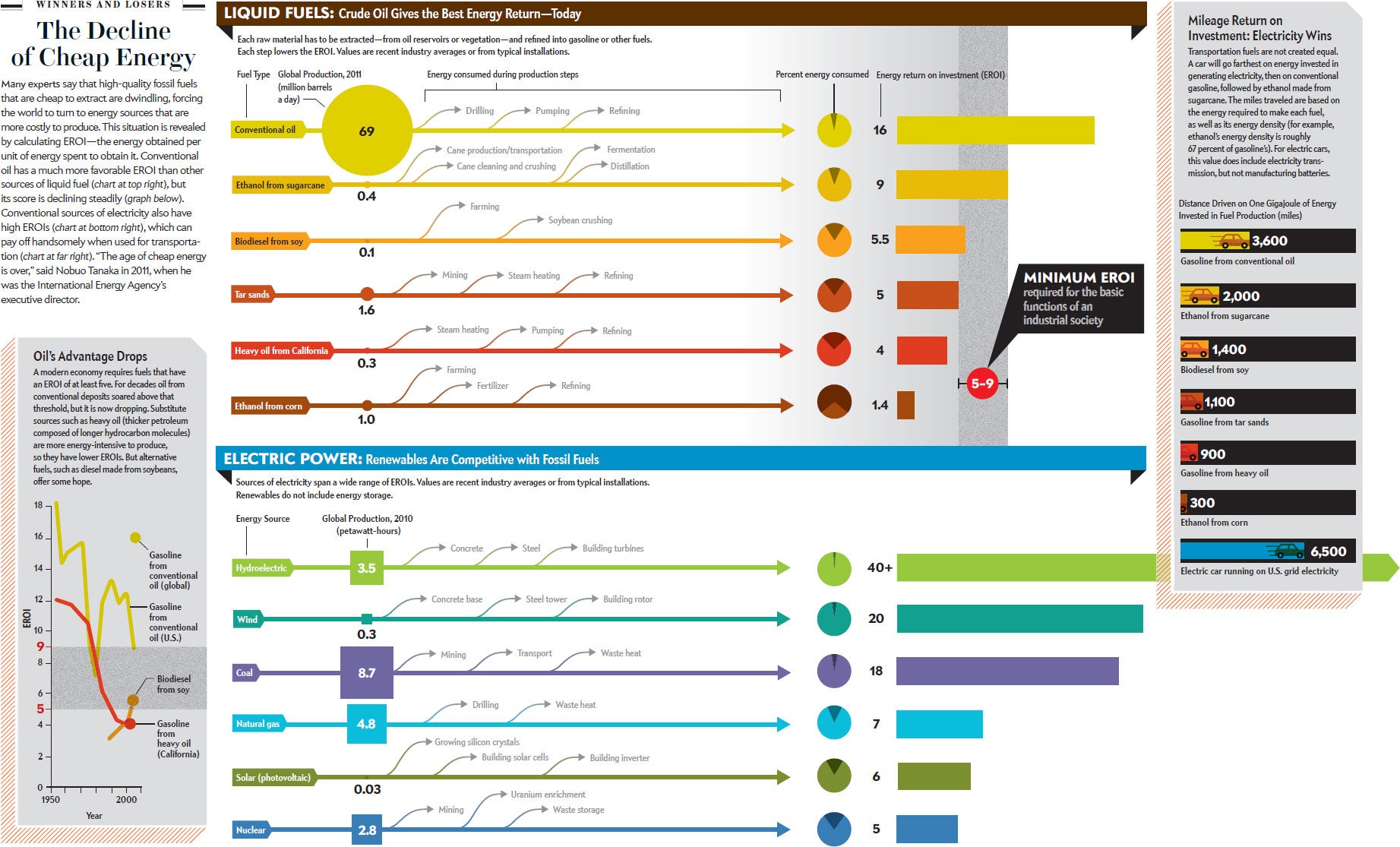
DATA SOURCES: INTERNATIONAL ENERGY AGENCY; U.S. ENERGY INFORMATION ADMINISTRATION; U.S. DEPARTMENT OF AGRICULTURE; STUDIES BY CHARLES A. S. HALL ET AL. AND BY OTHER RESEARCHERS (complete list of sources online at ScientificAmerican.com/apr2013/eroi)