
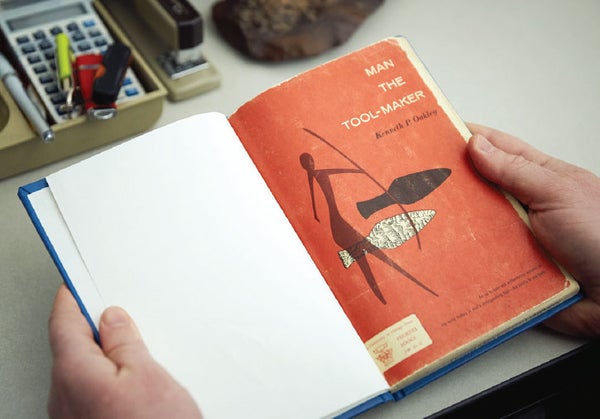
“We did get some funny looks when we first started wheeling carts of rocks into a state-of-the-art neuroimaging lab,” writes Dietrich Stout in this issue's cover story, “Tales of a Stone Age Neuroscientist.” What were they doing? A bit of experimental archaeology designed to help scientists understand the evolution of our higher mental faculties.
Among other experiments, volunteers chipped away at hunks of stone, shaping them into an ax or a knife. Afterward, neuroimaging recorded how the activity had changed the brain. Stout, who says it took some 300 hours to learn to chip stone properly himself, and others are finding insights into our ancient selves through scans of the brains of modern humans who have been making such stone implements. Put another way, while the ancients sculpted the world around them, their toolmaking helped to shape what's inside our skulls today. As it turns out, both manual and language skills may rely on some of the same brain structures. Stout and others have proposed that the neural circuits that got rewired in toolmaking were then co-opted to support early forms of communication, including gestures and maybe even vocalizations. Continuing experiments will help put those ideas to the test, giving new (positive) meaning to the idea of having “rocks in our heads.”
Brains are often thought of as our mental “computers.” Now, taking processing to a new level, synthetic biologists are developing ways to put living cells to work as biocomputers. A tiny bit of computing logic in a living cell could detect disease in patients or be used in numerous ways in agriculture or pharmaceutical manufacturing. Timothy K. Lu and Oliver Purcell describe various facets of “Machine Life.”
On supporting science journalism
If you're enjoying this article, consider supporting our award-winning journalism by subscribing. By purchasing a subscription you are helping to ensure the future of impactful stories about the discoveries and ideas shaping our world today.
One of the pleasures of the human brain, as opposed to other thinking machines, is its ability to wonder. For me, at least, the fundamentals of how the universe might work never cease to inspire. Consider the puzzle of the neutron lifetime. Inside an atomic nucleus, a typical neutron endures for long periods. But outside of that, Geoffrey L. Greene and Peter Geltenbort write, it will decay “in 15 minutes, more or less.” Two precision experiments can't agree on how long neutrons live. Is the cause measurement errors or some deeper mystery? Therein lies “The Neutron Enigma.”