
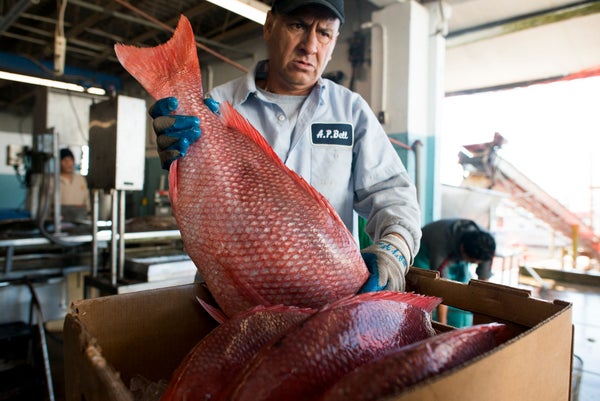
In the heavily fished waters of the Gulf of Mexico, the red snapper has made a notable comeback. Strict US government regulations have helped to rebuild its stocks after overfishing caused a population crash in the 1980s and 1990s. Now the fish faces a new challenge: President Donald Trump, a Republican who wants to cut roughly US$50 billion from the government’s civilian agencies in 2018.
Trump’s plan would eliminate the Missi-ssippi-based Sea Grant program that is poised to oversee a $12-million study of red-snapper stocks. Its findings are meant to guide future management decisions, and to protect a fishery that hauls in billions of dollars per year for the Republican-dominated gulf states. Now the study’s fate is uncertain—along with those of many other government science programs, including some that largely benefit the voters who propelled Trump into office.
In 2014, about $35 billion—or nearly one-third of all federal research dollars—flowed to states that voted Republican in the most recent presidential election, a Nature analysis found. Economists have documented how this type of government investment shores up local economies, says Mark Muro, a senior fellow and policy analyst at the Brookings Institution, a think tank in Washington DC. “Many smaller communities have a huge amount to lose,” he says.
On supporting science journalism
If you're enjoying this article, consider supporting our award-winning journalism by subscribing. By purchasing a subscription you are helping to ensure the future of impactful stories about the discoveries and ideas shaping our world today.
US politicians have long worked to spread federal research and development (R&D) largesse around the country. In 1862, Congress established the land-grant system of universities to teach agriculture and engineering, with many institutions located in newly established states. After the Second World War, politicians created a network of national labs, including facilities in rural areas that had secretly worked on the atomic bomb during the war.
Today, some federal agencies deliberately distribute funds to parts of the country beyond the elite research powerhouses. The National Science Foundation sets aside $160 million from its $6-billion research budget to award university grants to states that routinely receive less than 0.75% from the agency’s ordinary funding channels. In recent years, the program has seeded an optics industry in Montana and carbon-cycle research in Alaska.
And in 2014, former US president Barack Obama created a national network of institutions to develop advanced manu-facturing technologies. Manufacturing jobs in the United States fell by 32% between March 1989 and September 2016, particularly in midwestern and ‘rust belt’ states. There are now 14 institutes in the ‘Manufacturing USA’ network, including a 3D-printing group in Youngstown, Ohio, and a lightweight-metals institute in Detroit, Michigan.

Credit: Nature, May 17, 2017, doi:10.1038/545273a; Source: NSF
An advanced-composites institute in Knoxville, Tennessee, works with wind-turbine and car manufacturers to make their products lighter and stronger. “It’s given us access to tools and resources and people we didn’t have before,” says Gregory Haye, general manager of Local Motors in Knoxville, which made the first 3D-printed car.
In January, an independent analysis by the Deloitte consulting firm found that Manufacturing USA is bringing together companies that would not otherwise connect. The US National Academy of Sciences is intrigued enough to plan a May 23 workshop that will assess the institutes’ successes and where they should go next. Yet their funding remains uncertain, because they were a pet project of Obama’s—and because the program’s cost is expected to reach nearly $1.9 billion as more institutes launch. A related program, the $130-million Manufacturing Extension Partnership for small manufacturers, is already on Trump’s chopping block, notes William Bonvillian, who studies innovation policy at the Massachusetts Institute of Technology in Cambridge.
So far, Trump has suggested only broad cuts to the federal budget; he is expected to release a more detailed 2018 spending proposal next week. But the president’s themes are clear: even as he speaks about bolstering blue-collar jobs, he suggests cutting some research that underpins rural economies. “The current priorities are very much at odds with our view of what R&D and innovation strategies would benefit the economy,” says Scott Andes, an analyst at Brookings. It is not clear to what extent Congress will go along with Trump’s plan, however.
In the meantime, federal scientists in Colorado are in the middle of a ten-year experiment that could improve the profitability of a quintessentially American activity: ranching. Government researchers have been working on the prairies here since 1939, after overploughing and drought led to devastating dust storms. Now they are exploring whether beef producers and conservation biologists can develop grazing practices that benefit them both.
Beginning in 2012, the group split ten short-grass pastures in half. On one side, ranchers graze cattle as they have traditionally. The other half is controlled by scientists, who manage the land for plant and bird biodiversity; they aim to establish a variety of range grasses and to help livestock better weather difficult years.
So far, the cattle on the traditionally managed pastures are gaining weight faster than those on the scientifically managed pastures. But the real test of the experiment, which has cost a little over $3 million since 2012, will come if Colorado experiences a severe drought. That will show which of the two approaches works better to feed cattle through hard times. “The whole idea is to use science to inform management,” says Hailey Wilmer, a rangeland scientist with the US Department of Agriculture’s Agricultural Research Service in Fort Collins, Colorado, which oversees the work.
This sort of federal investment could help the cattle country of the American West. “I’d take anything into consideration,” says Jeff Wahlert, a rancher in Grover, Colorado, who runs cattle on the test pastures. “There’s always something that you can try to help your operation.”
This article is reproduced with permission and was first published on May 17, 2017.