
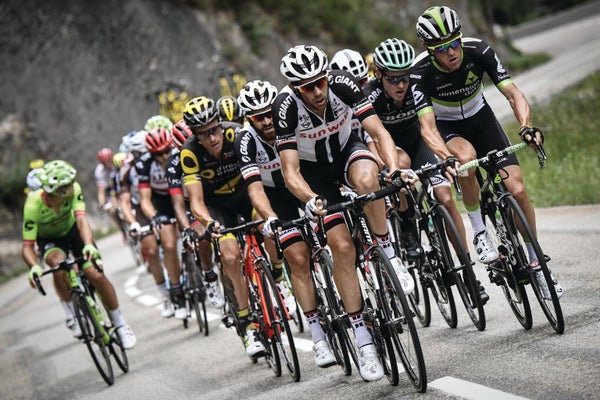
Like a school of fish or flock of birds, a pack of bicycle riders (technically called a “peloton”) often behaves like a unified entity. When individuals engage in simple small-scale behaviors, a collective pattern emerges that helps the whole. But in densely packed groups, it can be unclear what determines each individual's behavior. Mathematicians and biologists have argued that cyclists' movements within a peloton are primarily driven by optimizing aerodynamics, but new research suggests a different explanation.
Jesse Belden of the U.S. Naval Undersea Warfare Center and Tadd Truscott of Utah State University have found that visual input plays a critical role in how cyclists position themselves within the pack: individuals subconsciously form a diamond-shaped pattern that optimizes their peripheral vision, helping them quickly respond to others' changes in motion.
Pairs of cyclists save the most energy when one rider follows closely behind another. But for pelotons, Belden says, “we don't see that pattern inside a group. Aerodynamics only matters at the outside edge—you save energy wherever you are inside a pack.” Previous studies in animals ranging from locusts to birds suggested that vision helps to shape the group as a whole, but they did not explain how it shapes individual behavior. To find out, researchers decided to study professional cyclists.
On supporting science journalism
If you're enjoying this article, consider supporting our award-winning journalism by subscribing. By purchasing a subscription you are helping to ensure the future of impactful stories about the discoveries and ideas shaping our world today.
While examining helicopter footage of Tour de France races, Belden, Truscott and their colleagues noticed two behaviors that caused fluidlike ripples through the peloton. In one, a rider would brake and other riders would slow to avoid a collision. In the other, a rider would move sideways to skirt an obstacle or fill a gap. These movements produced waves moving forward and backward or left and right through the peloton, respectively. The left-right waves propagated relatively slowly—at the speed it takes a human to respond to an immediate neighbor's motions. The forward-backward waves, however, propagated much faster, implying that individuals had anticipated changes in response to the motion of someone two riders ahead.
These wave findings suggest that vision is the main influence on individual rider behavior because riders want to keep neighbors within the range of peripheral vision most sensitive to motion. Apart from long-term race goals, each cyclist's main objective is to avoid crashing; riders do so by maintaining a position that lets them focus on what is in front while keeping more space between side-flanking neighbors. The work was presented last November at the 71st Annual Meeting of the American Physical Society Division of Fluid Dynamics.
The researchers say their findings could be applied to explain collective animal behavior, help optimize exit plans in crowded spaces or program collections of autonomous robots.