
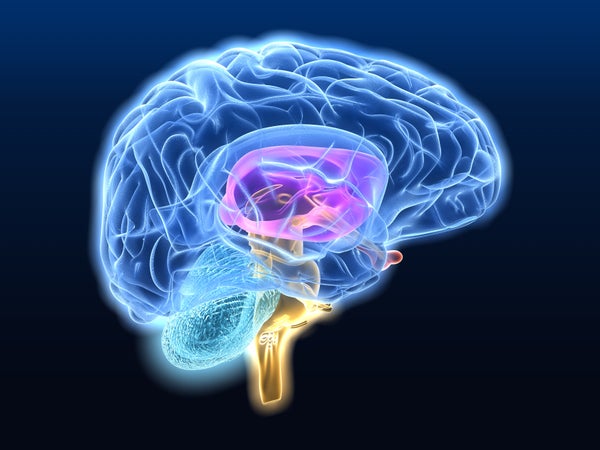
Early Homo sapiens wasn't acquainted with Einstein's general theory of relativity, yet anyone in a physics class today is expected to understand its basic tenets. “How is it that our ancient brains can learn new sciences and represent abstract concepts?” asks Marcel Just, a neuroscientist at Carnegie Mellon University. In a study published in June in Psychological Science, Just and his colleague Robert Mason found that thinking about physics prompts common brain-activation patterns and that these patterns are everyday neural capabilities—used for processing rhythm and sentence structure, for example—that were repurposed for learning abstract science.
Just and Mason scanned the brains of nine advanced physics and engineering students as they thought through 30 physics concepts such as momentum, entropy and electric current. The researchers fed the data from the scans into a machine-learning computer program, which eventually could identify which concept a volunteer was thinking about based on his or her brain activity. Why was this possible? Because the neural patterns involved in considering a particular topic—gravity, for instance—were the same in all participants. “Everyone learns physics in different classrooms, with different teachers, at different rates,” Mason says. “So it's surprising that the same brain regions are developed for understanding a physics concept in all these students.”
To take it further, the scientists then compared the scans from their study with previous research matching neural activity to thought processes. They found that brain responses corresponding to the scientific concepts of “frequency” or “wavelength” occurred in the same regions that activate when people watch dancers, listen to music or hear rhythmic patterns such as a horse's gallop—likely because these all involve sensing “periodicity.” And when the students thought through mathematical equations, the engaged brain areas were the same as those that process sentences. These results suggest that general neural structures are repurposed for dealing with high-level science.
On supporting science journalism
If you're enjoying this article, consider supporting our award-winning journalism by subscribing. By purchasing a subscription you are helping to ensure the future of impactful stories about the discoveries and ideas shaping our world today.
“So even though some of these concepts have only been formalized in the past couple of centuries, our brains are already built to deal with them,” Just says.
The findings may someday help determine which school lessons should be taught together for easiest consumption, Mason says. He and Just plan on continuing their work with other sciences our ancestors knew little about, including genetics and computer science.