New Issue: Orbital Catastrophe Ahead? Read Now

How zoos prepare for winter storms

This weekend’s freezing temperatures and snow won’t just affect humans—zoo animals need to get ready for the coming storm, too

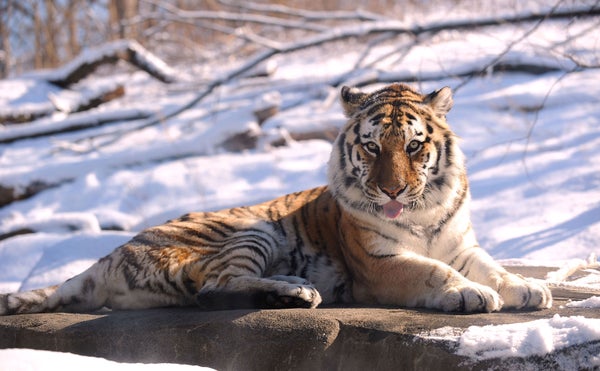
A tiger perches on a rock slab with snow in the background

A tiger enjoys the winter weather at the Bronx Zoo in New York City in 2009.

James Devaney/Getty Images

Join Our Community of Science Lovers!

Millions of people across the U.S. are bracing for a massive winter storm this weekend, with plummeting temperatures, “catastrophic” ice accumulation, freezing rain and heavy snow all expected, officials say. But humans aren’t the only ones hunkering down; zoos across the country are gearing up for the winter storm, too.

In Texas, the Houston Zoo has prepared its buildings and barns with heaters “designed to withstand extreme conditions,” the zoo said in a blog post on Friday. Animals will have access to extra hay and bedding, and food was stocked in advance. “Across the Zoo, sensitive plants are being protected with coverings, and generators are positioned to provide backup power if needed,” the blog post said.

Elsewhere in the state, the Dallas Zoo reportedly plans to bring many of its animals indoors and to ramp up enrichment activities like caretaker trainings, food puzzles and nature sounds. “Humans can stay inside and watch Netflix,” said zoo curator Keith Zdrojewski to the Dallas Morning News. “When animals are inside for days, it can get pretty boring for them.”


On supporting science journalism

If you're enjoying this article, consider supporting our award-winning journalism by subscribing. By purchasing a subscription you are helping to ensure the future of impactful stories about the discoveries and ideas shaping our world today.


Similarly, Fort Worth’s zoo has brought its endangered Pan’s box turtles inside, the Fort Worth Star-Telegram reported. Meanwhile in Cincinnati, animal care staff plan to stay at the zoo overnight to keep an eye on the animals, according to the Cincinnati Zoo. And in Washington, D.C., if temperatures dip below 35 degrees Fahrenheit (1.7 degrees Celsius), as they are currently projected to do, species at the Smithsonian’s National Zoo, including Asian small-clawed otters, brown pelicans, orangutans and gorillas, will likely be taken indoors, too, according to the zoo’s standard procedures.

Other animals, of course, will be just fine in the cold. At the Philadelphia Zoo, officials expect Marcy the snow leopard to be thriving this weekend, according to a local news report. And in Sedgwick County, Kansas, an Amur tiger, a species that is very well-adapted to low temperatures, reportedly “loves” the cold.

Jackie Flynn Mogensen is a breaking news reporter at Scientific American. Before joining SciAm, she was a science reporter at Mother Jones, where she received a National Academies Eric and Wendy Schmidt Award for Excellence in Science Communications in 2024. Mogensen holds a master’s degree in environmental communication and a bachelor’s degree in earth sciences from Stanford University. She is based in New York City.

More by Jackie Flynn Mogensen

Subscribe to Support Independent Journalism

Great science journalism requires human expertise, time, effort and creativity. And it costs money. That’s why I and the journalists here at Scientific American hope you’ll join our community.

When you subscribe, you are supporting staff and freelance journalists who are passionate about telling science stories that are true, important and compelling. Our editors and reporters are often experts in their fields, which means they understand the nuances of big discoveries and can untangle the breakthroughs from the hype. With a subscription, you are also supporting rigorous fact-checking to ensure the words we publish are precise and accurate. And you’re supporting original illustrations, graphics and photos that bring you closer to an advanced laboratory, an ice sheet in Antarctica or a space mission in orbit. You’re helping us craft other types of high-quality journalism as well: Our newsletters are carefully written, edited and curated by staffers you have or will come to know and love. Our Science Quickly podcast is based on original reporting, collaboration with editors and scientists and exacting production.

Subscriptions keep this engine running so we can continue to deliver thoughtful, rigorous and independent science journalism to you. In an era of viral misinformation, this work is crucial. If you value what we do, I hope you’ll consider joining us as a subscriber

Thank you,

Jeanna Bryner, Editor in Chief, Scientific American

Subscribe