
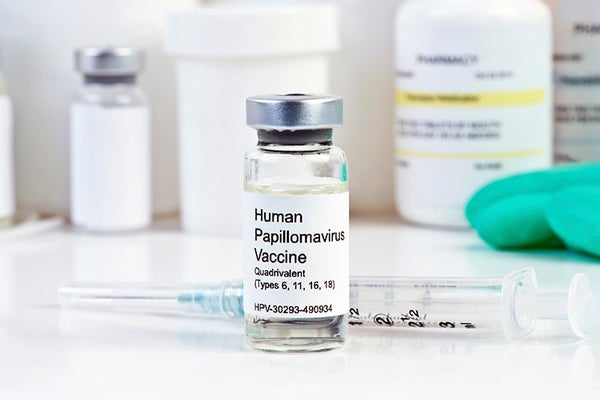
(Reuters Health) - A new vaccine for the cancer-causing human papillomavirus (HPV) has led to a dramatic decrease in infections among teen girls and young women, but many children still aren't getting inoculated, a U.S. study suggests.
Within six years of the U.S. vaccine debut in 2006, there was a 64 percent decline in the prevalence of four vaccine-preventable strains of the virus among girls aged 14 to 19 and a 34 percent drop among women aged 20 to 24, researchers report in the journal Pediatrics.
"HPV vaccination has the potential to prevent up to three out of four HPV-associated cancers," said lead study author Dr. Lauri Markowitz of the Centers for Disease Control and Prevention in Atlanta.
On supporting science journalism
If you're enjoying this article, consider supporting our award-winning journalism by subscribing. By purchasing a subscription you are helping to ensure the future of impactful stories about the discoveries and ideas shaping our world today.
HPV is among the most common sexually transmitted diseases. Most infections don't cause symptoms and go away on their own, but the virus is a still leading cause of cancer deaths among women worldwide. It can also cause genital warts and lesions in the upper respiratory tract.
In the U.S., the HPV vaccine is recommended for children at age 11 or 12 years, with the goal of protecting them against the virus before they become sexually active, and also for teens and young adults who may not have previously been vaccinated.
But just 40 percent of girls and 22 percent of boys have received the three-dose series of shots needed to fully protect against the virus, Markowitz added by email.
"National HPV vaccination rates are low, leaving girls vulnerable not only to cervical cancer, but also to other cancers caused by HPV infections (i.e. vaginal, vulvar, anal and oropharyngeal cancers)," Markowitz added. "HPV infections can also lead to cancers of the anus, penis, and oropharynx in boys, so these low rates also leave boys vulnerable to HPV cancers."
To see how the vaccine influenced infections, Markowitz and colleagues reviewed national health survey data from 2003 to 2006, before the vaccine debut, and compared it to data from 2009 to 2012.
The prevalence of HPV among females aged 14 to 19 dropped from 11.5 percent before the vaccine was available to 4.3 percent afterwards.
For women aged 20 to 24, prevalence declined from 18.5 percent to 12.1 percent.
Before the vaccine became available, the prevalence of vaccine-preventable strains of HPV was 18.6 percent among sexually active 14 to 24 year olds. After the vaccine was introduced, the prevalence dropped to 2.1 percent among those who got vaccinated but only dipped to 16.9 percent among those who didn't get vaccinated.
While the results highlight the effectiveness of the vaccine in slowing the spread of HPV strains, adoption of the vaccine has been slower than expected, the authors note.
Many girls and boys don’t receive the vaccine at least in part because their parents may question whether it’s necessary to protect them against a sexually transmitted disease at an age when they think children shouldn’t be having sex, researchers say.
Beyond resistance to the vaccine from some parents, some pediatricians may not prioritize this vaccine as much as inoculations against other childhood diseases, researchers also note.
"Doctors are not recommending it enough," Dr. Cora Breuner, an adolescent specialist at Seattle Children's Hospital who wasn't involved in the study, said by email.
Healthcare providers need to take the time to help parents understand the rationale behind the HPV vaccine, and stress that children need it before they become sexually active to make it an effective tool for cancer prevention, said Dr. Ruth Lynfield, a pediatrics researcher and medical director of the Minnesota Department of Health.
"HPV vaccine needs to be given prior to exposure to these viruses in order to be effective in preventing infections with these viruses, and there is also a good immune response to the vaccine in early adolescence," Lynfield, who wasn't involved in the study, said by email.
"It is fine if it is given many years before a person becomes sexually active," Lynfield added. "It needs to be stressed that it is a cancer prevention vaccine."
SOURCE: bit.ly/1UifRGM Pediatrics, online February 22, 2016.