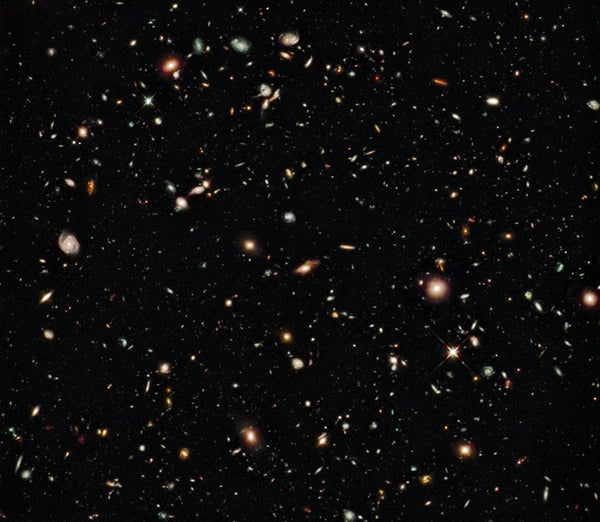
The Hubble Space Telescope has taken advantage of its beefed-up hardware to peer deep into the universe, spotting galaxies that existed just 600 million years or so after the big bang.
NASA, ESA, G. Illingworth (UCO/Lick Observatory and the University of California, Santa Cruz), R. Bouwens (UCO/Lick Observatory and Leiden University), and the HUDF09 Team
Join Our Community of Science Lovers!
On supporting science journalism
If you're enjoying this article, consider supporting our award-winning journalism by subscribing. By purchasing a subscription you are helping to ensure the future of impactful stories about the discoveries and ideas shaping our world today.
The Hubble Space Telescope has taken advantage of its beefed-up hardware to peer deep into the universe, spotting galaxies that existed just 600 million years or so after the big bang. In the image above, the faint, red objects are the most distant, but countless closer galaxies are discernible, as well.
The image comprises 48 hours of exposure time on Hubble's new Wide Field Camera 3 (WFC3), stretched out over a four-day period in August. In May, shuttle astronauts paid Hubble what will likely be its final visit by Earthlings, installing WFC3 and repairing or replacing a number of other instruments and parts. With the space shuttle scheduled for retirement next year and no replacement astronaut launcher at the ready, NASA's hope was to maximize the telescope's longevity and scientific usefulness, giving it another five to 10 years of operational life.
Hubble's ability to peer into the early cosmos and reveal what a typical slice of the universe looks like at depth has been a boon to astronomers for years. In 1996, the space telescope produced the so-called Hubble Deep Field image with WFC3's predecessor, the Wide Field and Planetary Camera 2. And in 2004, another Hubble camera, the Advanced Camera for Surveys, took an even deeper look into the universe with the Hubble Ultra Deep Field.
Subscribe to Support Independent Journalism
Great science journalism requires human expertise, time, effort and creativity. And it costs money. That’s why I and the journalists here at Scientific American hope you’ll join our community.
When you subscribe, you are supporting staff and freelance journalists who are passionate about telling science stories that are true, important and compelling. Our editors and reporters are often experts in their fields, which means they understand the nuances of big discoveries and can untangle the breakthroughs from the hype. With a subscription, you are also supporting rigorous fact-checking to ensure the words we publish are precise and accurate. And you’re supporting original illustrations, graphics and photos that bring you closer to an advanced laboratory, an ice sheet in Antarctica or a space mission in orbit. You’re helping us craft other types of high-quality journalism as well: Our newsletters are carefully written, edited and curated by staffers you have or will come to know and love. Our Science Quickly podcast is based on original reporting, collaboration with editors and scientists and exacting production.
Subscriptions keep this engine running so we can continue to deliver thoughtful, rigorous and independent science journalism to you. In an era of viral misinformation, this work is crucial. If you value what we do, I hope you’ll consider joining us as a subscriber
Thank you,
Jeanna Bryner, Editor in Chief, Scientific American