Hubble Telescope Stops Collecting Data after Mechanical Fault

A malfunctioning gyroscope has temporarily hobbled the aging space observatory

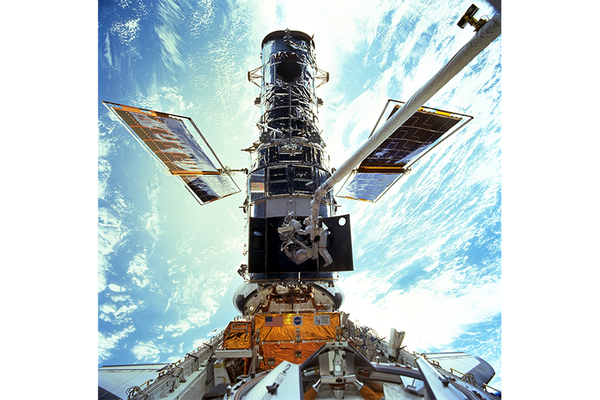
Astronauts work on Hubble during a 1999 mission to service its gyroscopes.

Join Our Community of Science Lovers!

The Hubble Space Telescope stopped collecting science data on 5 October, because of a problem with one of the gyroscopes that the observatory uses to orient itself on celestial targets. Mission controllers are investigating the problem and expect to have Hubble working again soon.

“Don’t worry, Hubble has many great years of science ahead,” says Kenneth Sembach, director of the Space Telescope Science Institute in Baltimore, Maryland, which operates Hubble.

But the glitch underscores that the 2.4-metre Hubble, perhaps the most iconic space observatory in history, will eventually die. NASA’s decision to retire its space shuttles in 2011 means that astronauts cannot service the 28-year-old observatory as they once did.


On supporting science journalism

If you're enjoying this article, consider supporting our award-winning journalism by subscribing. By purchasing a subscription you are helping to ensure the future of impactful stories about the discoveries and ideas shaping our world today.


On their last servicing mission in May 2009, astronauts replaced all six of Hubble’s gyroscopes. Three of those were of a new design meant to last much longer than the previous designs. The one that failed was the first of the new model to go.

Hubble can operate on just two gyroscopes, or even one, but that limits its ability to point at targets. Its successor, the 6.5-metre James Webb Space Telescope, will not launch until 2021 at the earliest.

This article is reproduced with permission and was first published on October 8, 2018.

It’s Time to Stand Up for Science

If you enjoyed this article, I’d like to ask for your support. Scientific American has served as an advocate for science and industry for 180 years, and right now may be the most critical moment in that two-century history.

I’ve been a Scientific American subscriber since I was 12 years old, and it helped shape the way I look at the world. SciAm always educates and delights me, and inspires a sense of awe for our vast, beautiful universe. I hope it does that for you, too.

If you subscribe to Scientific American, you help ensure that our coverage is centered on meaningful research and discovery; that we have the resources to report on the decisions that threaten labs across the U.S.; and that we support both budding and working scientists at a time when the value of science itself too often goes unrecognized.

In return, you get essential news, captivating podcasts, brilliant infographics, can't-miss newsletters, must-watch videos, challenging games, and the science world's best writing and reporting. You can even gift someone a subscription.

There has never been a more important time for us to stand up and show why science matters. I hope you’ll support us in that mission.

Thank you,

David M. Ewalt, Editor in Chief, Scientific American

Subscribe