
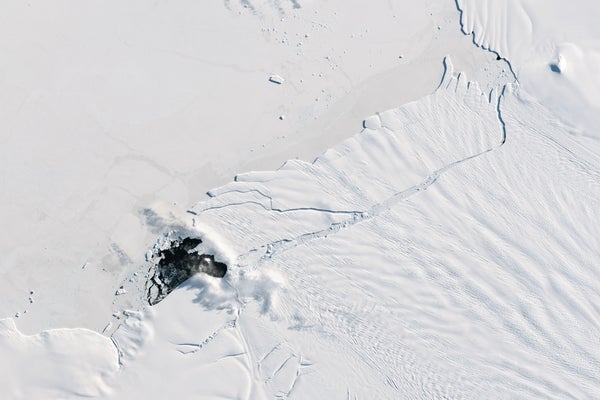
A newly discovered long and craggy rift is splintering across West Antarctica’s Pine Island Glacier, satellite images show.
The nearly 19-mile-long (30 kilometers) rift started in the middle of the ice shelf, where the ice shelf touches warmer ocean waters that are melting it from underneath, said Stef Lhermitte, an assistant professor in the Department of Geoscience and Remote Sensing at the Delft University of Technology in the Netherlands.
The rift only has about another 6 miles (10 km) to go before one or more icebergs calf, breaking off from the glacier, Lhermitte said. Another such event happened a mere year ago in 2017, when an iceberg 4.5 times the size of Manhattan broke off Pine Island Glacier. [Photo Gallery: Antarctica’s Pine Island Glacier Cracks]
On supporting science journalism
If you're enjoying this article, consider supporting our award-winning journalism by subscribing. By purchasing a subscription you are helping to ensure the future of impactful stories about the discoveries and ideas shaping our world today.
The upcoming ~300km iceberg (or its disintegrated pieces) will be the next large calving event after iceberg B-44 last year and the 6th large calving of #PIG since 2018 [2/n] pic.twitter.com/LdJ2caJrhv
— Stef Lhermitte (@StefLhermitte) October 4, 2018
Lhermitte found the new crack by analyzing satellite images of the glacier, which he receives every day in his email inbox. “It was Wednesday evening [Oct. 3] and all of a sudden I saw something I didn’t see the day before,” he told Live Science.
If the iceberg breaks off in one piece, it will be a whopping 115 square miles (300 square kilometers), which is even larger than the one that broke off last year. (The 2017 iceberg was 103 square miles, or 267 square km.)
If the resulting iceberg is large enough, it will receive a name, Lhermitte noted. But, regardless of whether the crack leads to one or many icebergs, this will be the sixth large-calving event that Pine Island Glacier has experienced since 2001, he said.
Granted, it’s natural for a glacier to calf icebergs. But what’s concerning about Pine Island Glacier is that it’s calving icebergs more frequently than it used to, Lhermitte said. Pine Island Glacier birthed icebergs in January 2001, November 2007, December 2011, August 2015 and September 2017.
The upcoming iceberg isn’t loose yet, “but the fact that the rift is almost across the entire glacier, it might happen relatively soon,” Lhermitte said.
It’s challenging, however, to say what “soon” means. According to Lhermitte, the calving event will likely happen in a matter of weeks or months, “but it probably won’t take years,” he said. “I expect this to happen from now to sometime this Antarctic summer.”
Once the breakage happens, the iceberg will likely stay frozen if it hangs out with the sea ice in the Antarctic. But if ocean currents carry it farther north, the iceberg will melt in the warmer waters, Lhermitte said.
Pine Island Glacier is one of the fastest flowing glaciers in Antarctica. Every year, it loses 45 billion tons (40.8 billion metric tons) of ice, which in turn causes sea levels to rise 0.03 inches (1 millimeter) every eight years, The Washington Post reported last year. Sea levels would rise 1.7 feet (0.5 m) if the entire glacier melted.
This video, which runs from 2002 to 2016, depicts just how much ice Pine Island Glacier is losing. (In the video, the colors yellow, orange, red and black represent ice loss, while blue indicates ice gain.)
Ice shelves are important because—like dirt clogging a sink that slows the drain of water—they impede the glacier from flowing full force out into the ocean, Lhermitte said. Once the upcoming calving event happens, Pine Island Glacier will have retreated nearly 4 miles (6 km), Lhermitte wrote on Twitter.
As for why Pine Island Glacier is losing more of its ice shelf (the icy portion that doesn’t touch the bedrock, but extends over the ocean), it’s hard to say. The warm water that is melting the ice shelf from underneath was pushed up from the deep ocean, Lhermitte said.
“The reason why we get this upwelling of warm water is certainly climate related, but it’s very difficult to say if this is climate change related,” he said. “Antarctica is a very sensitive continent for climate change. But for this individual iceberg, this is impossible to infer.”
Copyright 2018 LiveScience.com, a Future company. All rights reserved. This material may not be published, broadcast, rewritten or redistributed.