
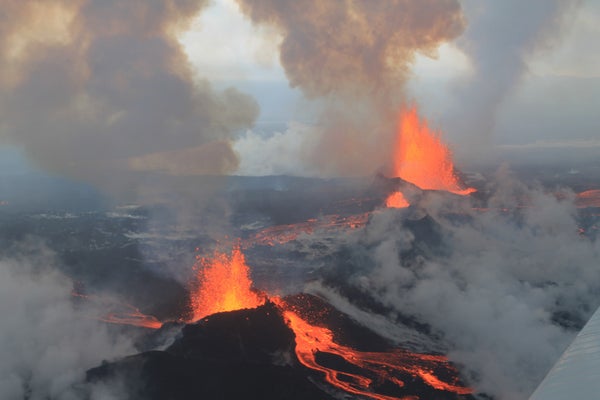
The largest Icelandic eruption in 230 years offers a unique look into how aerosols affect the atmosphere—and an international team of researchers says it could sharpen the way scientists model climate change.
The Holuhraun lava field explosion of 2014 and 2015 released enormous amounts of sulfur dioxide. SO2 is one of the most significant aerosols from industrial sources and is a key factor in cloud formation, creating the nucleus around which water vapor can condense.
Using climate models combined with satellite data from NASA and the Université libre de Bruxelles to study cloud formation around the Icelandic eruptions, the researchers found that the water vapor formed smaller droplets. That led to brighter clouds, which reflected more sunlight back into space and provided a cooling effect on the climate.
On supporting science journalism
If you're enjoying this article, consider supporting our award-winning journalism by subscribing. By purchasing a subscription you are helping to ensure the future of impactful stories about the discoveries and ideas shaping our world today.
Despite the smaller droplets, the researchers found that the aerosols had no discernible effect on other cloud properties, including the amount of liquid water in the clouds.
The researchers believe those findings show that clouds are “well buffered” against changes in the atmosphere caused by aerosols.
The results, in turn, suggest that climate scientists are getting a better idea of the magnitude of aerosols’ impact on climate change, which has so far remained murky.
“This study not only gives us the prospect of ending this uncertainty but, more crucially, offers us the chance to reject a number of existing climate models, which means we can predict future climate change far more accurately than ever before,” Florent Malavelle, the lead author and a research fellow at the University of Exeter’s mathematics department, said in a statement announcing the findings, published yesterday in Nature.
The researchers’ confidence stems from the unique circumstances of their observations.
Between 40,000 and 100,000 tons of SO2 was released into the atmosphere each day during the six-month Holuhraun eruption—more than the daily emissions from all 28 countries in the European Union.
And unlike explosive volcanic eruptions that shoot aerosols miles into the stratosphere, the Holuhraun event released aerosols at altitudes similar to human-caused emissions—creating the “perfect natural experiment” for studying how aerosols interact with clouds, Malavelle said.
Reprinted from Climatewire with permission from E&E News. E&E provides daily coverage of essential energy and environmental news at www.eenews.net.