
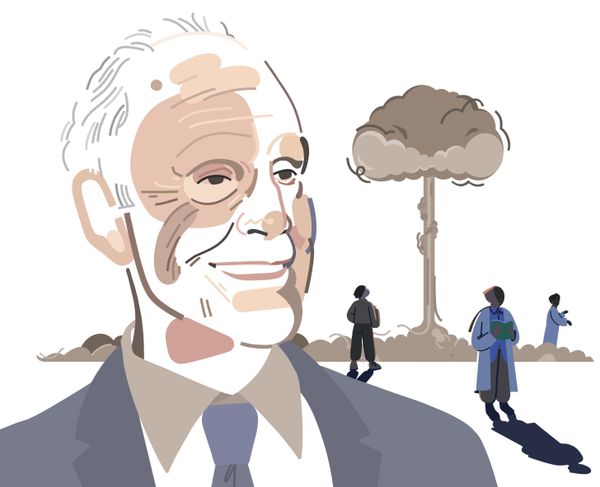
David J. Gross, a celebrated U.S. theoretical physicist, calls himself an optimist—especially concerning the future of his field. He’s certain that somewhere out there lurks a final, unified theory of nature, just waiting to be discovered. But he’s pessimistic about our chances of actually discovering it; on balance, he estimates, it’s more likely that we’ll destroy ourselves in nuclear warfare first. And as the latest recipient of a $3-million Special Breakthrough Prize in Fundamental Physics, he’s using the opportunity to warn the world of this dire peril.
When Gross speaks, especially about prospects of a unified theory, people tend to listen—after all, he’s responsible for some of the biggest steps we’ve taken toward devising one.
Such a theory would, by definition, unify three known fundamental forces—electromagnetism and the strong and weak nuclear forces—with a fourth, gravity, reconciling a long-standing schism between these domains. In the early 1970s Gross co-discovered a phenomenon called asymptotic freedom, a counterintuitive property of the strong nuclear force showing that interactions among quarks (the subatomic constituents of neutrons and protons) weaken at shorter distances and strengthen at longer ones. In other words, the farther apart you try to pull quarks, the harder they’ll resist. But if you pile them together inside a proton, they will frolic freely, almost as if they have no resistance at all.
On supporting science journalism
If you're enjoying this article, consider supporting our award-winning journalism by subscribing. By purchasing a subscription you are helping to ensure the future of impactful stories about the discoveries and ideas shaping our world today.
The idea has been exhaustively confirmed in high-energy experiments, and it helped to establish a theory of the strong force called quantum chromodynamics (QCD), which became a cornerstone of the Standard Model of particle physics. It also netted Gross a share of the 2004 Nobel Prize in Physics. In the aftermath of QCD’s ascendance, his quest for unification turned more speculative as he formulated foundational aspects of string theory, specifically a mathematically elegant hybrid type he co-developed in the 1980s called heterotic string theory, which mixes other types to describe fundamental particles. Unlike asymptotic freedom, however, heterotic string theory (and string theory in general) has yet to be validated by experiments.
Although the connection between these technical contributions and the existential threat of nuclear warfare may seem tenuous, Gross maintains it’s quite clear: Centuries of further theoretical and experimental progress may be required to find and verify a final theory—but planning for such a future is shortsighted when global nuclear war could effectively end human civilization in a single afternoon. Reducing that risk, he says, is therefore at least as important for discovering a unified theory as performing the fundamental physics work itself.
In a conversation with Scientific American, Gross discussed his Breakthrough Prize, the reasons for slow progress toward a unified theory and the folly of ballistic missile defense. And he explained why the current status quo means everyone now on Earth still faces the threat of nuclear annihilation.
An edited transcript of the interview follows.
You’ve won several major awards during your long career—the Dirac Medal in 1988, the Harvey Prize in 2000 and of course the Nobel Prize in Physics in 2004. Now you’ve won this year’s $3-million Special Breakthrough Prize in Fundamental Physics as well. Do you consider this the capstone?
Nothing really compares to the Nobel Prize, but this one is certainly the most lucrative. I’ve been heavily involved in raising money for my institute, the Kavli Institute for Theoretical Physics at the University of California, Santa Barbara, and for many others like it around the world. So with this Breakthrough Prize, it’s nice to finally have some money to give to other people!

Theoretical physicist David J. Gross attends the 12th Breakthrough Prize Ceremony at Barker Hangar on April 18, 2026, in Santa Monica, Calif., where he received a Special Breakthrough Prize in Fundamental Physics.
Taylor Hill/FilmMagic/Getty Images
You know, this is a “lifetime achievement” prize, which carries the suggestion that my lifetime is drawing to a close. So that’s a bit of a bummer. But I’m still extremely honored and pleased by it—the way these Breakthrough Prizes work is that the selections are informed by the opinions of previous recipients, and in this case, those are some of the people I respect most in my field. And this prize is more flexible and open-ended than most others; it can go to people whose work is still somewhat speculative and is as yet unconfirmed by nature.
You seem to hit both sides here in that some of your work—asymptotic freedom in quantum chromodynamics, for example—has been well validated by experimentation, whereas other aspects, such as heterotic string theory, remain quite speculative. Is that a fair assessment?
Well, I’ve had a long life so far! I’ve seen extreme swings in fundamental physics. When I was beginning, it was during a period of experimental supremacy, with enormous discoveries being made all the time—and on the theoretical side, almost nothing was understood. That was an exciting period for a theorist. And now it’s sort of the opposite. There are a lot of great theoretical ideas and progress, but nature hasn’t been so kind with its discovery. And living through both periods—and everything in between—has of course shaped my work.
It used to be that the data were all there, and one tried to make predictions based on flimsy ideas. Now new data aren’t coming, but the theory is so much more understood. So the goal now is to advance the theory and hopefully to make contact with experiment, but that’s getting harder all the time. In the past, you could make a prediction or try to calculate something and have it tested experimentally within a year! Now it’s “look, we’re planning the future of the field on a 30- to 60-year timescale.”
What’s caused that slowdown? Just things getting more expensive?
Not exactly. The projects themselves have gotten bigger, which makes them take longer. But they haven’t really become more expensive: given inflation, technological growth and our increased understanding of the physics, we can build better machines with less money now.
What’s changed has to do with the scales of distance or energy that we’re exploring rather than the scale of time that we usually think about when discussing our progress into the future. From the point of view of physics, the most important scale is the size, or the distance, that we can probe, with smaller distances requiring greater energies to reach.
So in the 20th century, we went from molecular to atomic to nuclear physics, to where we were studying the structure of the atomic nucleus. Across the past two centuries, we’ve progressed by roughly 15 or 20 orders of magnitude. And this enormous progress gave us a very complete “standard” theory of particle physics.
But the next scale that is suggested by experimental observation and theoretical extrapolation is many orders of magnitude removed from the current scale that we can easily explore. We seem to have another 20 orders of magnitude to go! And it gets worse: One of the major implications of asymptotic freedom in QCD and other quantum field theories is that the physics changes very slowly as we go to shorter and shorter distances. Specifically, it changes logarithmically.
Let’s compare that with another scale, which is the amount of money it takes to reach those higher and higher energies to go to those shorter and shorter distances. For this, the cost scales at least as the energy squared, if not even more. So the physics potential is increasing only logarithmically while the cost is increasing like the energy squared—there’s an exponential difference between them. And that’s just a fact of life we’ll have to deal with if we want to understand nature at these small scales.
The math is daunting, to say the least. That makes me wonder: Was that calculus part of what’s motivated your work in advocacy and activism outside of physics? That’s something your Breakthrough Prize acknowledges in its citation. You’ve been a prominent signatory on open letters to U.S. presidents protesting budget cuts to science programs and on declarations calling for action on climate change and on nuclear nonproliferation, for instance.
I think you can do both—scientific research and public advocacy. It’s not either/or, and it’s a personal decision everyone has to make about what to do with their limited time. Science really is a lot of fun; I enjoy it a lot. But it’s very different from my advocacy work. I guess getting prizes like this can be a devil’s bargain in that context. On one hand, the exposure you receive means you’re often urged to be an advocate, to help get some message out. On the other hand, this can be an enormous drag on your time.
“I’d estimate that the annual chance for nuclear war is now 2 percent.” —David J. Gross, Nobel Laureate in Physics
Right now I and others are helping to rekindle what’s known as the Mainau process by co-creating a group that we call the Nobel Laureate Assembly for the Prevention of Nuclear War. We’re involved at the United Nations. We’ll be doing something in Brussels next year. We had a big conference in Chicago in July 2025—even the pope is interested in what we’re doing; he sent a cardinal as an emissary to that meeting. We’re now planning a whole series of events at the Vatican.
And all of this involves warning people and institutions around the world to wake up to the danger of nuclear annihilation. Because there is something we can do; we can stop this danger. We need to raise people’s awareness about this—especially young people, most especially scientists. I could even work on you. May I ask: Do you have children?
I do. I have two sons, aged 11 and six.
Okay. And what do you think their mean lifetime will be?
I hope it’ll be at least as long as the lives of their recent ancestors—how long my grandparents lived, for instance, which was pretty close to the national average, I think. You know, somewhere between 75 and 80 years old, if all goes well, at minimum.
Right, of course. Incidentally, some of this line of questioning comes from a 2024 bestseller by Annie Jacobsen entitled Nuclear War: A Scenario. You should read it. And if you do, you’ll be scared—as you should be.
What you should be really scared about is the estimates from serious experts during the 20th century that there was a 1 percent annual chance of nuclear war. That doesn’t sound like much; it’s the sort of thing people shrug off, especially if they have no memory of the cold war. You know, “We’ve never had any nuclear war; we’re never gonna have it; no problem.” But if the chance is 1 percent a year, well, that suggests the mean lifetime of someone born today is just 67 years. This assumes that if nuclear war occurred, they’d die as a result—which, I’d argue, is a pretty safe assumption.
And the scariest part is: in the years since those estimates were made, things have gotten so much worse. Today all nuclear arms control treaties have been abrogated, proliferation has expanded as more countries gain or seek nuclear weapons, and there’s even a major war with nuclear-armed Russia going on in Europe. I would conservatively estimate that the annual chance for nuclear war is now 2 percent.
Translate that into what this might mean for your children, and you’re looking at them having a mean lifetime of about 35 years. It’s like the radioactive decay of an atom—it may be a low-probability extreme event, but the more time passes, the more likely such events are to occur. The probability accumulates. That’s the way we should really think about this. So this will probably affect your lifetime as well but certainly theirs; their mean lifetime today, unless something is done, may be just 35 years.
That is scary.
It is, yes. And what people need to know is that there are things one can do about this that don’t consist of entirely abolishing nuclear weapons or everyone on Earth becoming a pacifist. The output of our Chicago meeting was a declaration that you can go read online; it lists some very simple steps that could be taken worldwide to reduce the risk—because we don’t want to be at 2 percent. If we can get to 0.1 percent, well, okay. That could give us a few hundred years to solve more of our problems, and any reduction could be an extension to the mean lifetime of your kids and certainly their grandkids.
You don’t have to convince me of the clear and present danger we face from nuclear war and the value in reducing the risk! But I’m sure there are people out there who would say this is like playing Whac-A-Mole because of all the other nonnuclear existential risks we face—anthropogenic climate change, hazardous space rocks, runaway artificial intelligence, and so on. And some of them might even say that “the only way out is through,” that instead of laboring to close the nuclear Pandora’s box, we should lean even harder on nuclear power and other disruptive technologies to somehow buy down existential risk.
That is, some critics might say that rather than collectively calling for more bureaucratic solutions, Nobelists like you should endorse more extreme goals such as radical geoengineering to combat climate change or building cities on Mars to create a backup plan for humanity. What would you say to those sorts of responses?
They sound rather silly, to say the least. You mentioned climate change, and I think the social response to that offers a good example of what’s needed to address the nuclear problem. I talk to very smart young physicists all the time, graduate students and postdocs and professors, and I’ll often ask them, “What are you worried about? Tell me your top five most important concerns about anything.”
Number one, almost universally, is climate. Usually from there, it’s things like diversity, tenure or inflation. No one mentions nuclear war. And these people are physicists! When I start questioning—“Do you know how many missiles there are? Do you know how long it takes for Donald Trump or Vladimir Putin to push a button? Do you know what a one-megaton nuclear bomb does?”—it seems they know nothing.
How can this be? Well, about 40 years ago scientists started warning the world about climate change. And it took a long time, but they succeeded in waking some of us up to become a strong political force despite the best efforts of the oil companies and their politicians. That’s also, by the way, how the previous attempts or successes in controlling nuclear weapons worked. That’s how the Comprehensive Test Ban Treaty was developed. There were millions of people in the streets protesting against the radioactive fallout from atmospheric weapons testing—testing that Trump says he wants to start again!
Of course, when the cold war ended, a lot of that sentiment fell by the wayside. People forget that the nuclear arsenals are still here.
So public action is key to achieving these sorts of goals, but currently no one talks much about the nuclear threat. Scientific American hasn’t written about this for who knows how many years—and you should!
It’s been a while, that’s true.
And I bet if you ask your colleagues there, you’ll see the lack of knowledge of the real danger is extreme. In any case, climate is being addressed because there is a strong political will to do it. Addressing it is a very long-term thing, and the changing climate by itself can’t kill all of humanity. Meanwhile, with global thermonuclear war, the whole human world, what we call civilization, practically everything and everyone can just vanish in 24 hours. Poof. Gone. It’s insane. And it’s insane that we aren’t doing anything about it!
Getting back to my contrarian prodding about technological panaceas, there’s of course an incredibly expensive plan underway, Golden Dome, to build a ballistic missile defense system that will supposedly be capable of protecting the entire continental U.S. As a physicist interested in nuclear issues, I’m sure you have thoughts.
Every new technology offers new hopes of solving the problem, but it simply won’t work. Golden Dome is not much more than Ronald Reagan’s “Star Wars” [ballistic missile defense program] on steroids. And serious analysis—which in the end convinced everybody, most important, Reagan and Mikhail Gorbachev—shows that offense easily wins over any defense you can mount. The best you can hope for with these things is another destabilizing arms race. It’s extraordinarily expensive and essentially ineffective. You’re located in New York City, right?
Yep, that’s right.
Right, and all it takes is one single warhead getting through. A single MIRV missile can shoot 10 half-megaton bombs at the New York area, and there are practically infinite ways to fool any kind of defense system. This is, in fact, being illustrated in front of our eyes with some of the drone warfare at work in Ukraine or the current missile defense situation in the Middle East, where offensive weapons that cost hundreds of thousands of dollars are being knocked down by defensive weapons that cost hundreds of millions of dollars. It’s a totally crazy thing, and even more than that, the argument for ballistic missile defense is what convinced some people in the U.S. that they could protect themselves while bombing other countries over the past 50 years.
Golden Dome will never work. Building it would bankrupt the U.S., and so it will never actually happen, and it’s therefore irrelevant to the main problem, which should be keeping your kids alive for more than 35 years.
Talking about the overlooked odds of nuclear annihilation and now the resurgence of ballistic missile defense as a seemingly unworkable solution, it’s tempting to think that history is somehow cyclical. Maybe we’re on the verge of making mistakes we were very lucky to avoid earlier—mistakes that carry such severe consequences they can be made only once. And if we avoid them now, well, leave it to the next generation to stumble perilously close to them once again. That’s a rather bleak outlook. I hate to be so cliché, but are you able to stay optimistic about the future?
I’m less optimistic than I was a few years ago. The politics in the U.S. and around the world are getting crazier and crazier.
But with the nuclear issue, this isn’t a force of nature that we have no control over. We can do something about it. These are systems built and controlled and maintained by people, in the end.
And so I do believe that if people became informed of the dangers—as many have, after many years, with respect to climate—we would have hope. Of course, in the case of climate change, nature has helped to prove the case, as was predicted.
I don’t want to see a small nuclear war that would kill “only” a few hundred million people and cause enormous destruction to the planet. But that might be how nature reminds us how precarious our situation really is. I hope not.
That doesn’t sound very optimistic.
So I am somewhat pessimistic about the nuclear situation. But in general, I’m an optimist—because that’s a prerequisite for doing frontier, speculative, basic physics, to probe these frontiers we talked about earlier that are so difficult to reach. There’s a selective bias at work here—you can’t do this kind of science unless you’re an optimist, because if you’re a pessimist, you give up so easily.
Attempting to understand the most basic laws of nature, seeking to understand the beginning of the universe and how the universe will end, finding a theory to unify all the forces—these are extraordinary, grandiose goals. And so it’s understandable that they won’t be answered simply and quickly.
I’ve often compared progress in this sort of fundamental research to climbing a mountain—and in the case of fundamental physics, we really have no idea how tall the mountain is. We’re in the dark, going up, up, up. And as optimists, we’d think the peak was within reach—but optimists tend to exaggerate. As pessimists we’d say, “It’s miles and miles higher still. I think we’ve gone far enough.”
But another way of measuring this progress, which I try to do when I’m feeling pessimistic, is to look back a year, or a decade, and ask, “How much have we learned?” And it’s always been the case for me, looking back, to say, “Oh, my God, it’s changed so much. We’ve understood so much. We were idiots back then!”
So we must remember that this can be a long journey. Progress is being made along the way. We just have no idea how far we have to go. And we have to make sure we don’t kill ourselves in the meantime.