
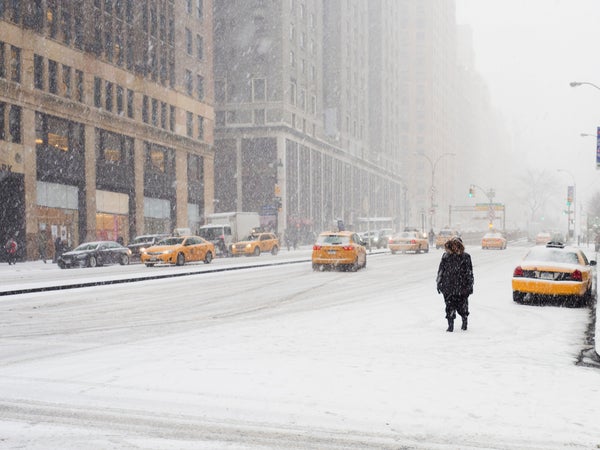
The cold snap that sent temperatures plunging last week and brought the most frigid new year in recorded history, in some places, had nothing to do with climate change, according to a new study.
In recent years, climate scientists have studied the connection between global warming and freezing temperatures. They are examining how shifting air patterns over the Arctic, and their incursion into North America and Europe, are connected to climate change.
But the two-week deep freeze didn't carry the hallmarks of human activity, according to a rapid attribution study from Climate Central, a science communication project based in Princeton, N.J. World Weather Attribution, a group of international researchers, performed the analysis.
On supporting science journalism
If you're enjoying this article, consider supporting our award-winning journalism by subscribing. By purchasing a subscription you are helping to ensure the future of impactful stories about the discoveries and ideas shaping our world today.
Temperatures in some parts of the country, including Buffalo and Detroit, were more than 20 degrees Fahrenheit below normal for this time of year. Such events are increasingly rare, and the group found that wintertime temperatures are actually increasing in the United States. That is to be expected in a warmer world, the authors wrote.
"We conclude that this was an exceptional two-week cold wave in the area in the current climate," the authors wrote. "Cold outbreaks like this are getting warmer (less frequent) due to global warming, but cold waves still occur somewhere in North America almost every winter."
That didn't stop politicians from seizing on the cold. President Trump tweeted that the East Coast "could use a little bit of that good old Global Warming," while former Vice President Al Gore tweeted that the bitter cold is "exactly what we should expect from the climate crisis."
Researchers found that such a cold spell was more likely before human-caused global warming. Now, a two-week deep freeze is about 15 times less likely to occur than a century ago, when temperatures in such an event would be 4 degrees lower, according to the international group of researchers. The cold streak was also unique in that it occurred so early in the season.
The group has looked at other extreme weather events. It found that the likelihood of Hurricane Harvey's rainfall was increased by climate change, but a drought in Somalia, in 2016 and 2017, was not connected to global warming.
There is evidence that Arctic blasts of frigid air could become more common as a result of climate change, though scientists say more study is needed to firmly draw any conclusions. That's because the jet stream around the Arctic region seems to be weakening. It typically traps and encircles the coldest air over the Arctic, but as it weakens, colder air can filter down to lower latitudes.
Scientists are looking at the link between the loss of Arctic sea ice and how it affects weather in lower latitudes, but more research is needed.
Gabriel Vecchi, a geosciences professor at the Princeton Environmental Institute and an author of the report, said the climate community is divided on whether or not colder winter temperatures can be traced to global warming. He said most experts in the field likely don't agree with that hypothesis, though he says there is evidence for it.
"The finding that cold spells could become more common due to global warming is an interesting one, but it is also a controversial one in our field," Vecchi said. "There is a lot of discussion about it in the scientific literature, and I think it's a very counterintuitive hypothesis that people have, and I think because of that, it's appealing. But we don't find any support for it in this work."
While the report failed to find human fingerprints on the cold weather, that doesn't raise questions about the broader role that people are having on the globe, he said.
"I think it would be misguided to look at any cold event as evidence for or against global warming," Vecchi said. "There is evidence for global warming on a number of levels, and the planet has been warming, the oceans have been taking up heat, sea levels have been rising, land snow has been melting, glaciers are melting, and all these other things, so the reality of global warming is uncontroversial."
Reprinted from Climatewire with permission from E&E News. E&E provides daily coverage of essential energy and environmental news at www.eenews.net.